

In 2025, the 10-Year Treasury will remain one of the most important benchmarks shaping bond markets and guiding investor strategies worldwide.
This 10-Year Treasury yield, tied closely to U.S. Treasury notes, influences everything from mortgage rates to corporate borrowing costs.
As markets navigate shifting inflation expectations and changing monetary policy, understanding where yields might head is crucial.
The performance of this benchmark also affects stock valuations, particularly in indexes like the S&P 500 index, and shapes global capital flows.
In 2025, factors such as economic growth, central bank strategies, and geopolitical events will all play a role in determining its direction, making an informed outlook more important than ever.
Additional insights into historical trends, investor sentiment, and bond market liquidity will further enhance the accuracy of any forecast, helping stakeholders prepare for both opportunities and risks that may arise throughout the year.
Current Status of the 10-Year Treasury Yield
As of early August 2025 the yield on the 10-Year Treasury note stands near 4.23 percent.
That reflects a rise from the record low of 0.51 percent seen in August 2020, a jump of nearly 400 basis points, which hit long-term bond holders hard (Barron’s, Advisor Perspectives, FRED).
This jump shows just how strongly bond yields can impact everyday borrowing costs and long-term investment returns.
This sharp move also signals a shift in investor sentiment toward safer assets, while influencing capital allocation across global markets.
Analysts suggest that if current economic trends persist, yields could remain elevated for longer, creating both challenges and opportunities for fixed-income and equity portfolios.
For a deeper perspective on how the 10-Year Treasury movements influence global capital markets, the analysis provided by U.S. Treasury’s official resource offers authoritative insights backed by real-time data and policy-driven updates.
Inflation Expectations and Real Rates

Inflation drives how high yields climb. The difference between yields on regular notes and TIPS (inflation-protected securities) gives “break-even inflation.”
Inflation remains a top factor influencing the 10-Year Treasury yield, directly impacting borrowing costs, mortgage rates, and overall investor sentiment.
That has moved above 2 percent as expectations rose due to tariffs on imports and energy price pressures (T. Rowe Price).
Meanwhile, real rates on TIPS at about 2.15 percent are elevated compared to historical norms.
Higher real rates signal that investors believe borrowing conditions will stay tough, even if headline inflation begins to cool.
Such dynamics can influence long-term borrowing costs, corporate investment decisions, and the attractiveness of fixed-income assets relative to equities in the broader market.
Federal Reserve Policy Expectations and the Term Premium
Yield also reflects where the Fed funds rate will go. Markets foresee cuts maybe pushing it toward 3.8 percent by year-end (Schwab Brokerage).
That expectation adds to the 10-year yield.
Another factor is the term premium — the extra return investors demand for holding longer-term bonds.
It rose sharply after U.S.-China trade tensions and is at decade-high levels (Schwab Brokerage).
This higher term premium indicates greater uncertainty about the economic outlook, prompting investors to demand more compensation for long-term commitments.
If geopolitical risks persist and fiscal pressures remain elevated, the term premium could stay high, keeping yields above historical averages even in a slowing economy.
Key Factors Influencing the 10-Year Treasury Yield
Economic signals such as GDP, consumer spending, jobs, and wages all play a role in shaping Treasury yields.
A strong economy usually lifts yields. Unemployment rate trends matter too.
Global investors are closely watching the 10-Year Treasury, as its movements ripple across currency markets, emerging economies, and international trade flows.
Investors tracking the 10-Year Treasury yields in 2025 should also explore how broader digital transformation in finance influences markets, as outlined in this Agile and Digital Transformation guide, which connects evolving technology with long-term financial strategies.
Finally crude oil prices and shifts in gold prices can sway inflation expectations, nudging bond yields.
When these factors align, they can create rapid yield shifts that impact borrowing costs and investment strategies worldwide.
Investors closely monitor such indicators to anticipate market movements, as even small changes can ripple through equity markets, corporate financing, and global trade dynamics.
Short-Term and Long-Term Yield Forecasts
Forecast models now expect the 10-year yield to ease slowly from 4.39 percent in July to about 3.53 percent by December 2025 (Financial Forecast Center).
Market momentum suggests a peak above 4.5 percent may hold before sliding.
A gradual drop could make a real difference for anyone buying a home or carrying debt.
Prolonged periods of elevated yields can lead to sustained pressure on housing affordability and corporate borrowing, while also attracting greater interest from income-focused investors.
This environment may encourage a shift toward longer-duration bonds, as investors seek to lock in higher returns before rates begin their anticipated descent.
Forecast Table
| Month | Forecast Yield (%) |
| Jul 2025 | 4.39 |
| Aug 2025 | 4.31 |
| Sep 2025 | 4.19 |
| Oct 2025 | 4.02 |
| Nov 2025 | 3.70 |
| Dec 2025 | 3.53 |
Impact on Mortgage Rates and Borrowing Costs

When the 10-Year Treasury Yield Forecast 2025 shifts, your mortgage rates often follow.
Higher yields tend to lift fixed-rate mortgages, making homes less affordable.
If yields fall, refinancing looks more appealing.
When long-term rates fall, loans for cars, student debt, and even small businesses usually become more affordable.
Over time this affects housing affordability and spending patterns.
Prolonged high yields can cool housing demand and slow construction activity, while sustained declines may stimulate real estate markets and consumer confidence.
Lenders also adjust their risk models based on yield trends, influencing credit availability and interest rate spreads for borrowers across different sectors.
Treasuries vs. Equities: Where Investors See Value
In a world where bond yields near 4.2 percent may match or beat stock returns over the next decade, investors re-weight toward bonds (Business Insider).
Equities like S&P 500 index, NASDAQ 100, or Magnificent Seven stocks still attract investors.
Yet stocks face pressure from rising yields, although Goldman Sachs notes that S&P returns have often stayed strong even when yields floated around 4.5 percent (Business Insider).
In the end, it’s about finding balance.
Diversifying across bonds and stocks is especially important in times like these, with many advisers suggesting a mix of high-quality bonds and equities across sectors.
This balanced strategy can help investors navigate volatility while capturing steady income and potential capital growth.
Historical Trends and Lessons from the Last Decade
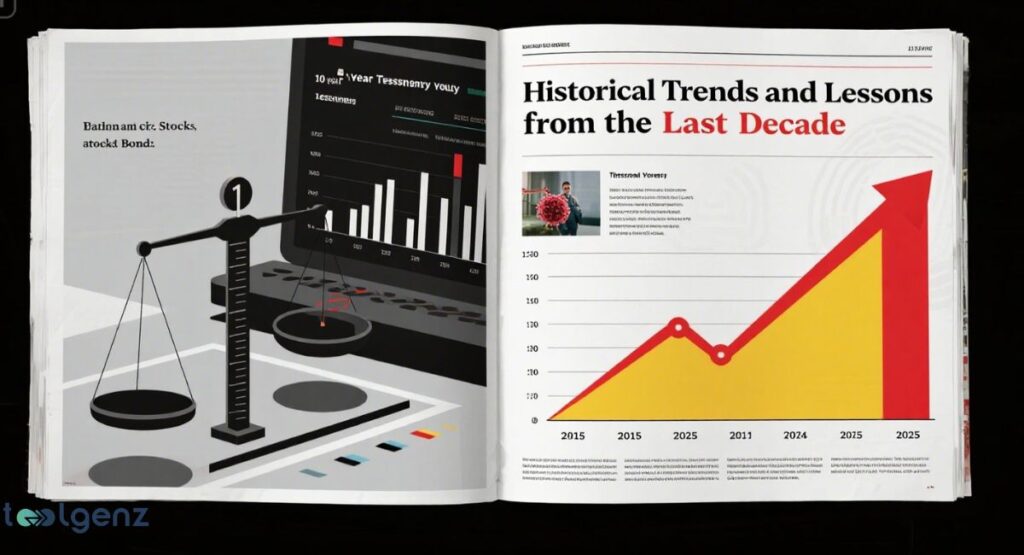
We learned a lot from how the 10-Year U.S. Treasury note behaved after the COVID plunge.
From 0.51 percent to above 4 percent meant great pain for fixed-income investors (Barron’s).
Equity investors saw bond and stock prices move together, breaking the usual pattern of negative correlation (T. Rowe Price).
The key takeaway: big yield swings can hit portfolios that rely too heavily on bonds or overlook risk management.
These shifts also reminded investors of the importance of monitoring macroeconomic signals, such as inflation trends and central bank policy shifts, to anticipate major market moves.
Incorporating a mix of asset classes and maintaining flexibility can help protect portfolios from unexpected interest rate shocks.
How Central Banks Use the 10-Year Yield in Monetary Policy
The Federal Open Market Committee (FOMC) watches long-term yields to gauge market sentiment on inflation and growth.
Major signals like yield curve inversion or steep yield curve inversion triggers can hint at recessions, guiding rate decisions.
Central banks globally, including those influenced by the People’s Republic of China (Beijing), study U.S. yields to align policies.
This interconnected approach means that shifts in the 10-year yield can have ripple effects across global credit markets, currency valuations, and trade flows.
As a result, maintaining stability in long-term rates becomes a shared objective among major economies to prevent financial imbalances and support sustainable economic growth.
Final Thoughts and Investment Takeaways

The 10-Year Treasury Yield Forecast 2025 shows a likely glide path from elevated levels in mid-year toward the mid-3 percent range by December.
If inflation eases and the Fed cuts rates, yields could fall more.
For homeowners, this means watch for refinancing windows.
For investors, bond exposure now looks more appealing versus stock-only portfolios.
A mix of Treasuries, equities, and even some gold can help investors stay resilient when markets shift unexpectedly.
Staying alert to economic indicators, global market trends, and policy announcements will be key to making timely adjustments.
Those who adapt quickly to shifting yield conditions may capture better returns while reducing overall portfolio risk.
FAQs
What is the 10-year Treasury rate forecast for 2025?
Analysts expect the 10-year Treasury yield to trend lower, moving from around 4.3% in mid-2025 toward the mid-3% range by year-end.
Are bonds expected to go up in 2025?
If interest rates fall as forecasted, bond prices are likely to rise in 2025.
What is a 10-year Treasury future?
It’s a standardized contract to buy or sell a 10-year U.S. Treasury note at a set price on a future date.
Can I sell a 10-year Treasury note early?
Yes, you can sell it anytime before maturity through the secondary market.
Should I buy 10-year Treasury bonds?
They can be a good option if you want steady income and safety, but returns may be modest compared to riskier assets.