

Understanding vertebrate axis formation research is key to unlocking how complex organisms develop from a single fertilized cell.
This process lays the groundwork for the anterior-posterior axis, dorsal-ventral axis, and overall body symmetry.
In early embryonic development, specific regions in the embryo, like the Spemann organizer and Nieuwkoop center, initiate signals that guide tissue layers into organized body plans.
These signaling events activate critical genes and shape structures such as the notochord and neural tube.
By studying axis formation, these signaling events are critical for proper axis formation during early development. Understanding axis formation helps improve stem cell and regenerative medicine applications.
This article explores mechanisms, historical breakthroughs, and modern research driving this fascinating field forward.
These discoveries also enhance stem cell research, regenerative medicine, and our understanding of vertebrate evolution.
With advancing tools in molecular biology, the field continues to uncover how early signals shape the future of life.
Vertebrate Axis Formation
Axis formation in vertebrates happens very early in development.
The embryo starts as a simple ball of cells. But soon, signals from certain cells begin to direct others where to go and what to become.
This is when the dorsal-ventral axis (back to belly) and the anterior-posterior axis (head to tail) are decided.
Key to this process are molecules and genes like the Wnt signaling pathway, β-catenin, and Sonic hedgehog (Shh).
These signals guide cells in arranging themselves into layers and deciding which organs they will become.
At the center of this process is the notochord, a structure that helps shape the neural tube — the foundation of the brain and spinal cord.
Understanding how these pathways interact helps scientists discover the causes of birth defects and guides progress in regenerative medicine.
Researchers continue to study how early axis cues lead to precise tissue formation in all vertebrate animals.
The Progressive Determination of the Amphibian Axes
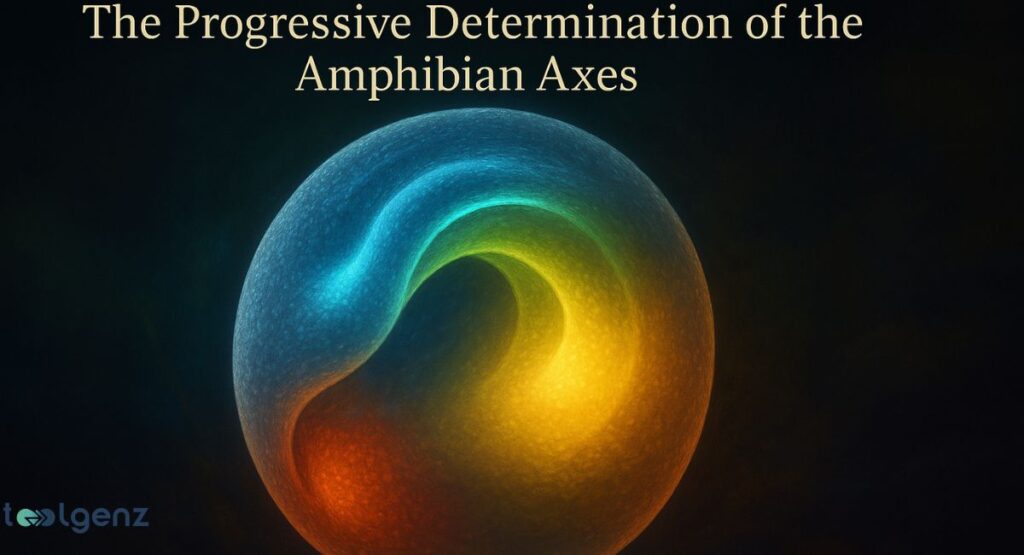
Studies of frogs, especially the species Xenopus, have helped researchers understand axis formation.
Frogs are ideal because their embryos develop outside the body and are easy to observe.
After fertilization, the egg shows a region called the gray crescent. This marks the future back of the animal.
Cells near this region will become the dorsal lip of the blastopore, the first opening in the embryo. This area is important for forming the body axes.
As development continues, cells are told what to become step by step. This is known as progressive determination.
These early experiments revealed that removing or transplanting the dorsal lip could redirect axis development, proving its powerful instructive role.
Such findings laid the foundation for many discoveries in developmental biology.
Hans Spemann and Hilde Mangold: Primary Embryonic Induction
The work of Spemann and Mangold in 1924 was a turning point.
They discovered that a part of the embryo called the Spemann organizer could guide the development of nearby cells.
When they moved this tissue to another part of the embryo, it formed a second body axis.
This experiment showed that the organizer sends powerful signals.
These signals are part of primary embryonic induction — meaning one group of cells can influence another group to form organs or body structures.
Their work gave rise to much of modern developmental biology.
Later studies identified molecules like Noggin, Chordin, and Goosecoid as key players in this process.
These discoveries helped uncover the molecular basis behind the organizer’s remarkable ability to control embryonic development.
The Functions of the Organizer
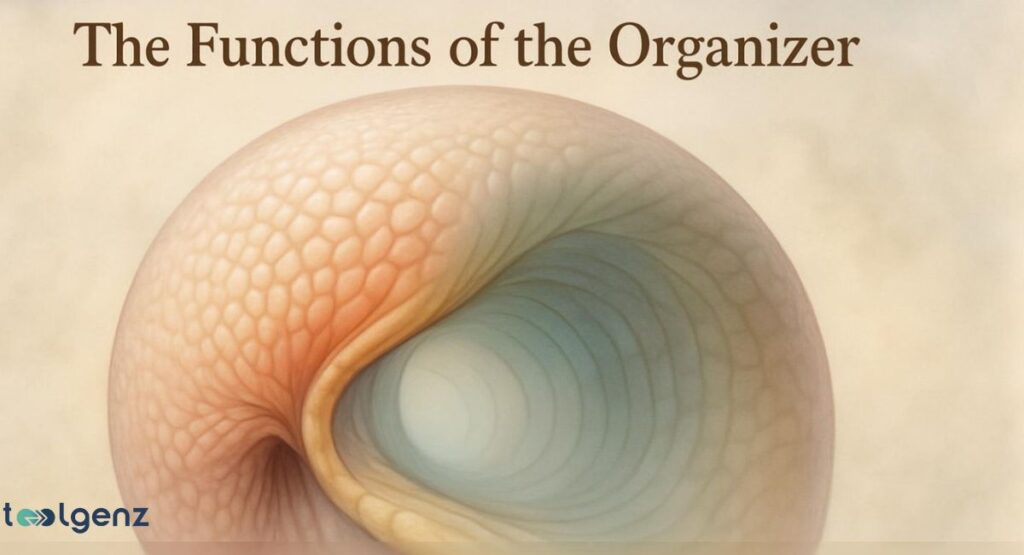
The Spemann organizer is found in the dorsal lip of the blastopore. It controls many parts of axis formation.
It sends out special molecules called BMP inhibitors, including Noggin, Chordin, and Follistatin.
They block BMP4 and BMP2, which would otherwise make cells become skin.
By stopping BMP4, these molecules allow cells to become the neural tube instead.
The organizer also helps shape the mesoderm, which will form muscles, the heart, and blood.
Genes like Goosecoid, Siamois, and Xbra are active here.
During gastrulation, these genes act like navigators, directing cells to the exact positions where they’re needed.
The Spemann organizer does more than shape neural tissue — it also helps establish the primitive streak, the notochord, and other key midline structures in the early embryo.
The Regional Specificity of Induction
The organizer is not the same throughout. Its parts do different jobs.
One area might form the head, while another forms the trunk.
Scientists have shown that if you take different pieces of the organizer and move them, they still form their original parts.
This reveals that different parts of the organizer have specialized roles, sending tailored signals that shape the anterior-posterior axis and steer development.
It also interacts with other key centers like the Nieuwkoop center and the node, which form signals important for the primitive streak and chordamesoderm.
These coordinated signals ensure that cells respond correctly based on their position.
This careful spatial control is what allows complex body plans to form reliably in vertebrate embryos.
Snapshot Summary: Early Development and Axis Formation in Amphibians
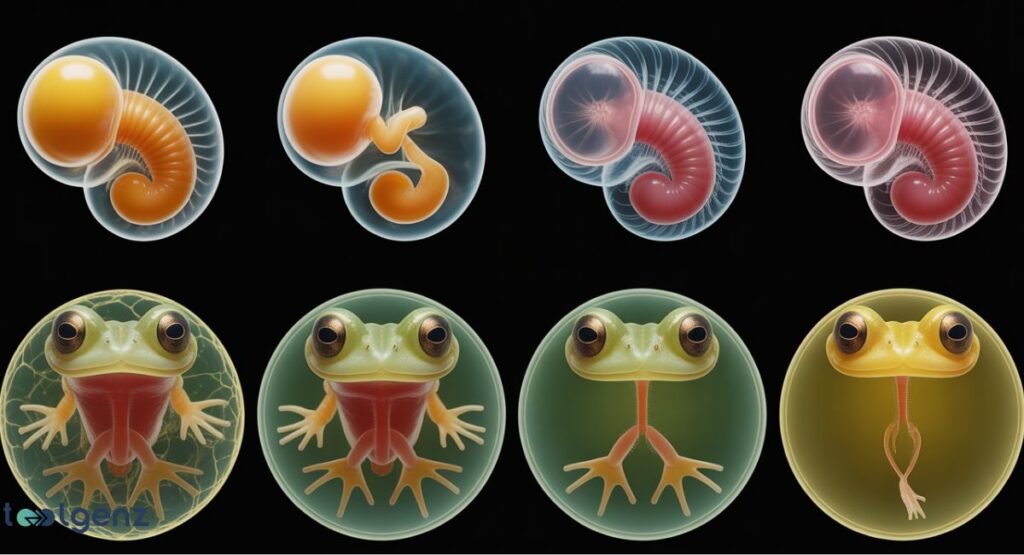
The early development in frogs gives a clear look at how vertebrate bodies form.
Here’s a quick summary in table form:
| Stage | Key Events |
| Fertilization | Gray crescent forms |
| Cleavage | Ball of cells created |
| Gastrulation | Formation of blastopore, dorsal lip, and layers |
| Axis Formation | Spemann organizer, notochord, and neural tube form |
The process of gastrulation begins the shaping of the body.
The epiblast gives rise to three layers: ectoderm, mesoderm, and endoderm.
The visceral endoderm and anterior visceral endoderm (AVE) also help signal where the head and brain will form.
As cells move through the primitive streak, they receive signals that tell them what type of tissue to become.
This movement and signaling are vital for forming the body plan.
Mistakes during this stage can lead to major birth defects or improper organ placement.
Key Terms
To understand this topic better, here are some important terms:
| Term | Meaning |
| Blastopore | Opening formed during gastrulation |
| Gray crescent | Region that marks the future dorsal side of the embryo |
| Dorsal lip | Site of Spemann organizer and primary induction |
| Spemann organizer | Group of cells that control axis formation |
| Gastrulation | Process of forming body layers |
| Notochord | Rod-like structure that helps form the neural tube |
| Primitive streak | Structure where cells move inward during gastrulation |
Key Points
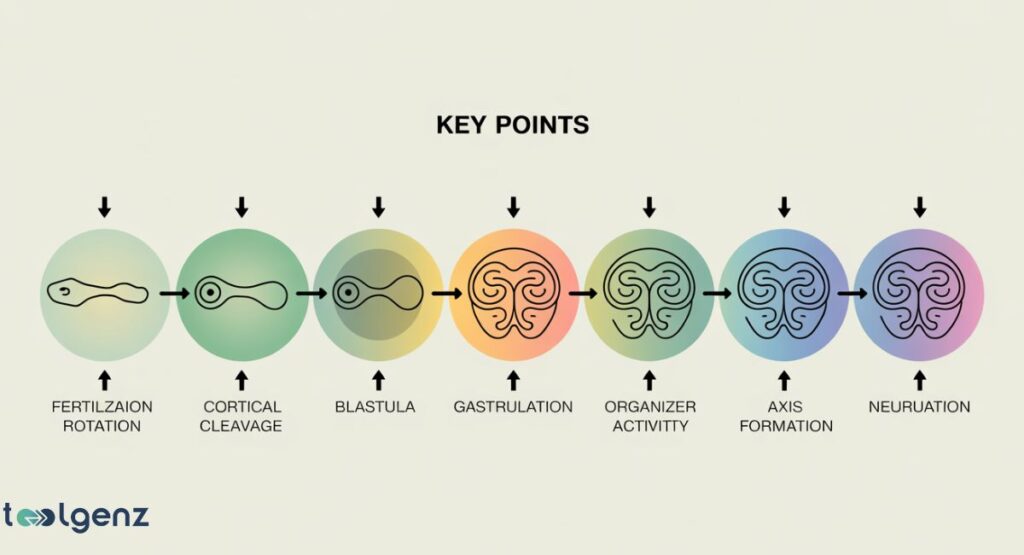
Axis formation in vertebrates is one of the first and most important steps in building the body.
The Spemann organizer, Wnt signaling, and BMP inhibitors are all key players.
Without these molecular signals, the brain, spinal column, and muscles could not develop in their proper form or function.
Research using frogs like Xenopus has uncovered the roles of many genes. Insights from studies on the axis certification program further highlight the importance of structured learning in developmental biology.
New methods using gene editing and live imaging now allow scientists in the USA to explore these steps in greater detail.
These tools have led to a better understanding of how cells talk to each other and how mistakes in these signals can lead to developmental disorders.
Ongoing studies aim to apply this knowledge to human health and regenerative medicine.
Contributions and Attributions
The discovery of primary embryonic induction by Spemann and Mangold is one of the greatest findings in developmental biology.
Their work with frogs led to the Nobel Prize for Spemann in 1935.
Today, labs across the USA use similar principles to study stem cells, regeneration, and birth defects.
Researchers also use newer models like mice and zebrafish.
They have found that proteins like Cripto, Smad2, Smad4, and TGF-β are part of the same pathways.
Genes like Lim1, Otx2, HNF3β, and Hesx1 control brain and body development in mammals.
This cross-species research helps confirm the universal nature of these developmental pathways.
Insights gained from these models are also advancing treatments for neurodevelopmental conditions and congenital abnormalities.
FAQs
What is axis formation?
Axis formation is the early developmental process by which the body’s main axes — anterior-posterior, dorsal-ventral, and left-right — are established in an embryo.
What is axial formation?
Axial formation refers to the development of the central body axis, including structures like the notochord and neural tube, which guide overall body organization.
What is the formation of Axis powers?
The formation of the Axis powers refers to the World War II alliance between Germany, Italy, and Japan, established through treaties and shared political goals.
How do axis formation and pattern formation differ?
Axis formation lays out the body’s main framework, while pattern formation fills in the details, creating features like limbs and organs in the right places.
What are the two types of axis?
The two main types are the anterior-posterior axis (head to tail) and the dorsal-ventral axis (back to belly).