
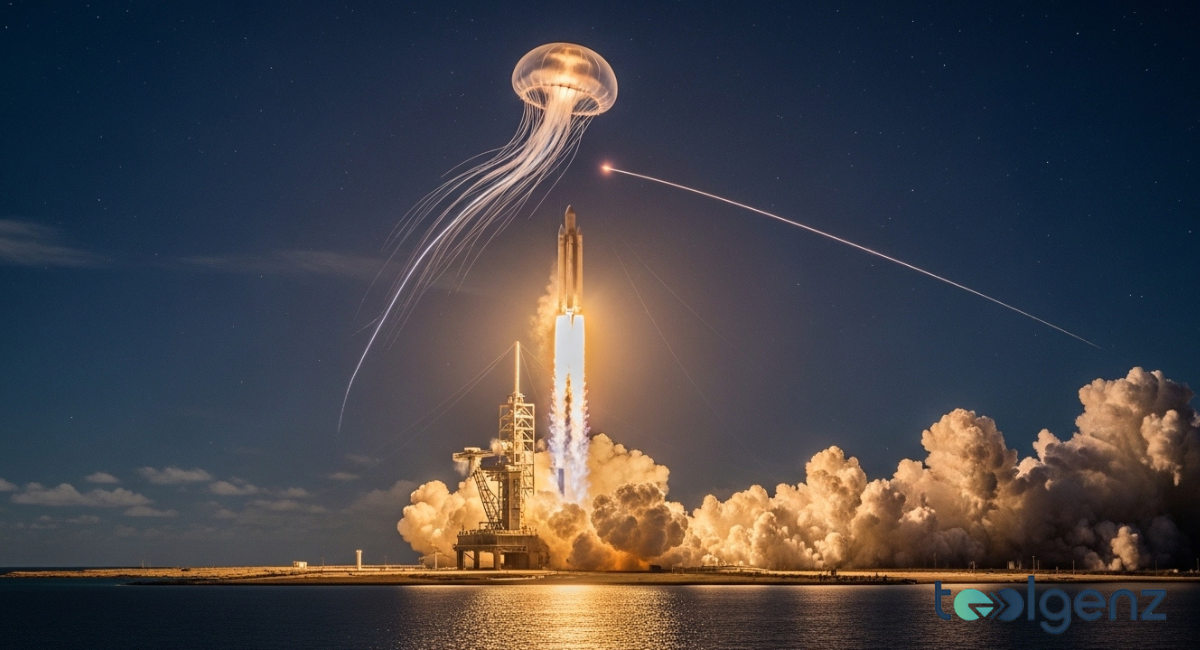
A powerful SpaceX rocket launch lit up Florida’s early morning sky, drawing attention from residents, space enthusiasts, and online viewers across the country. Just before sunrise, the Falcon 9 rose from Cape Canaveral, carving a bright arc along the Atlantic coastline. The timing created perfect conditions for one of the most visually striking displays a SpaceX rocket launch can produce.
For many viewers, the mission was about more than satellites or schedules. It was a reminder of how routine access to space has become. What once felt rare and historic now happens regularly, yet each flight still carries a sense of anticipation as engines ignite and the rocket climbs into the dark-blue horizon.
Liftoff from Cape Canaveral: Predawn Starlink Mission Details
At 5:52 a.m., the SpaceX rocket launch lifted off from Launch Complex 40 at Cape Canaveral Space Force Station. Engines roared to life, and within seconds the vehicle cleared the tower, heading northeast along the Eastern Seaboard. This SpaceX rocket launch followed a carefully calculated trajectory designed to position a fresh batch of Starlink satellites into low Earth orbit.
Weather conditions cooperated. Skies were partly cloudy, temperatures hovered in the mid-60s, and winds remained light. From ignition to stage separation, the SpaceX rocket launch unfolded smoothly, with the first stage detaching just minutes after liftoff while the upper stage continued pushing toward orbit.
The mission’s purpose was clear: expand broadband coverage through Starlink, particularly in rural and underserved communities. Each satellite added to the growing constellation already circling Earth.
What Is the “Space Jellyfish” Effect?

During this SpaceX rocket launch, spectators witnessed the so-called “space jellyfish” effect. The phenomenon occurs when a rocket climbs high enough to catch sunlight while the ground below is still in darkness. As the exhaust plume expands in the upper atmosphere, sunlight illuminates it from above, creating a glowing, translucent shape that appears to float across the sky.
Moments like this remind people that a SpaceX rocket launch can be both technical and beautiful. The science behind the glow is straightforward—light scattering through exhaust particles but the result feels almost otherworldly. The contrast between shadowed land and sunlit vapor trails produces shimmering streaks of pink, silver, and violet.
Spectacular ‘Jellyfish’ Forms Over Florida’s Space Coast
As the SpaceX rocket launch climbed higher, the plume widened dramatically over the Atlantic Ocean. Residents from Brevard County to Orlando stepped outside to watch the sky transform. Some described it as a luminous sea creature suspended above the coastline.
Photos of the SpaceX rocket launch quickly spread across social media platforms, with many viewers expressing surprise at how far inland the display was visible. Popular viewing areas such as Cocoa Beach and Titusville offered especially clear perspectives, though even distant observers reported faint glowing trails near the horizon.
The peaceful conditions added to the experience. With no sonic booms expected across central Florida, spectators could simply watch in silence as the light show unfolded overhead.
Falcon 9 Booster Landing on Drone Ship A Shortfall of Gravitas
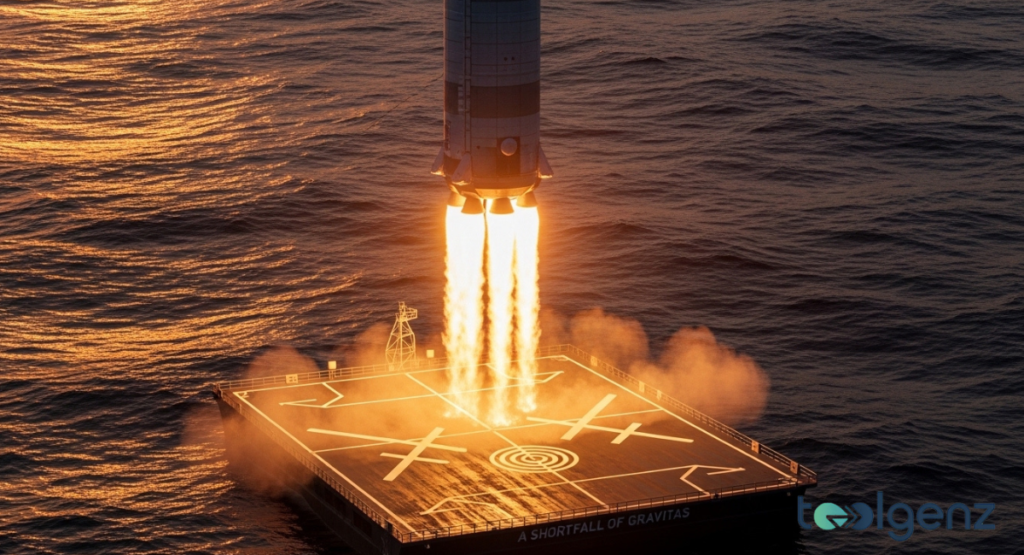
While the spectacle captured public attention, engineers focused on the first stage returning from the SpaceX rocket launch as it began its descent back toward Earth. After separating from the upper stage, the booster executed a series of controlled burns to slow its speed and guide itself toward a drone ship stationed in the Atlantic.
A successful recovery is now a routine part of a SpaceX rocket launch. The autonomous vessel, “A Shortfall of Gravitas,” waited hundreds of miles offshore. As the booster approached, landing legs deployed in the final moments before touchdown, completing another precise recovery.
Because of this approach, the SpaceX rocket launch did not produce sonic booms over heavily populated inland areas. Reusability remains one of the company’s defining strategies, allowing boosters to fly again and significantly reducing mission costs over time.
Countdown, Fueling & Webcast Highlights
In the final hour before the SpaceX rocket launch, teams loaded RP-1 kerosene and super-chilled liquid oxygen into the vehicle. Fueling continued until the last minutes of the countdown, following a tightly choreographed sequence refined through years of experience.
By the time the SpaceX rocket launch reached T-minus zero, onboard computers had taken full control. Engine chill procedures, system checks, and ignition all occurred in rapid succession. Viewers watching the live webcast saw the bright flash at the base of the rocket, followed by the steady climb into the pre-dawn sky.
The broadcast provided real-time updates on stage separation, fairing deployment, and booster landing confirmation, offering transparency into each critical milestone.
Launch Weather & Conditions at Cape Canaveral
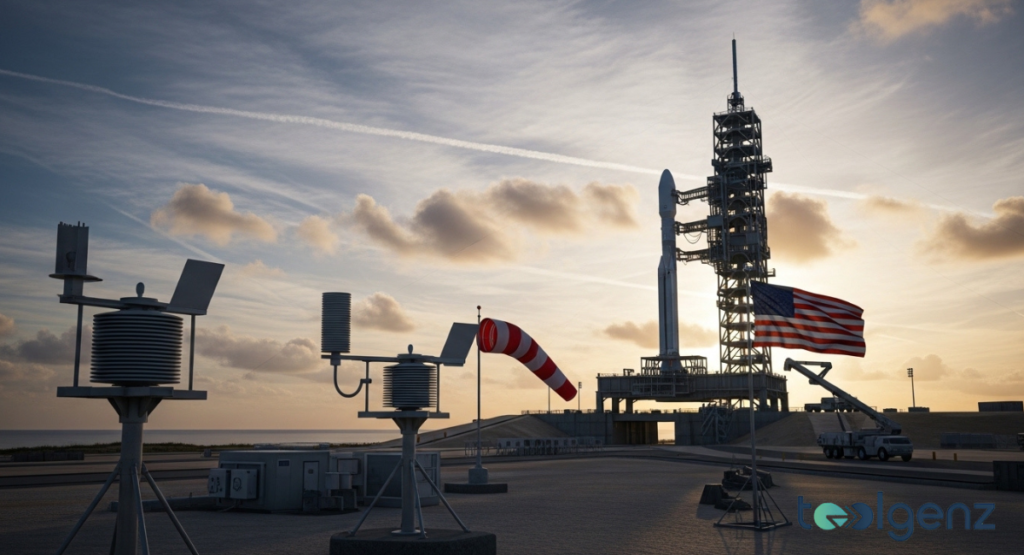
Clear conditions helped ensure the SpaceX rocket launch remained on schedule. Weather is always a deciding factor for Florida missions, particularly when lightning, thick cloud cover, or high winds threaten safety.
On this morning, however, atmospheric clarity worked in everyone’s favor. The low sun angle contributed directly to the jellyfish effect, enhancing visibility across the region. Even minor shifts in cloud cover could have muted the display, but timing and conditions aligned almost perfectly.
Starlink Expansion & Future Starship Missions
The main objective of this SpaceX rocket launch was to deploy additional Starlink satellites into low Earth orbit. The expanding network continues to provide high-speed internet to households in remote areas, maritime users, and even disaster response teams.
With every SpaceX rocket launch that adds satellites to orbit, coverage becomes more consistent and capacity improves. The long-term vision includes integrating direct-to-device connectivity and eventually shifting heavier payloads to the larger Starship vehicle currently under development.
As technology evolves, satellite batches may grow larger and more capable, increasing efficiency with each mission.
SpaceX’s 2026 Florida Launch Cadence
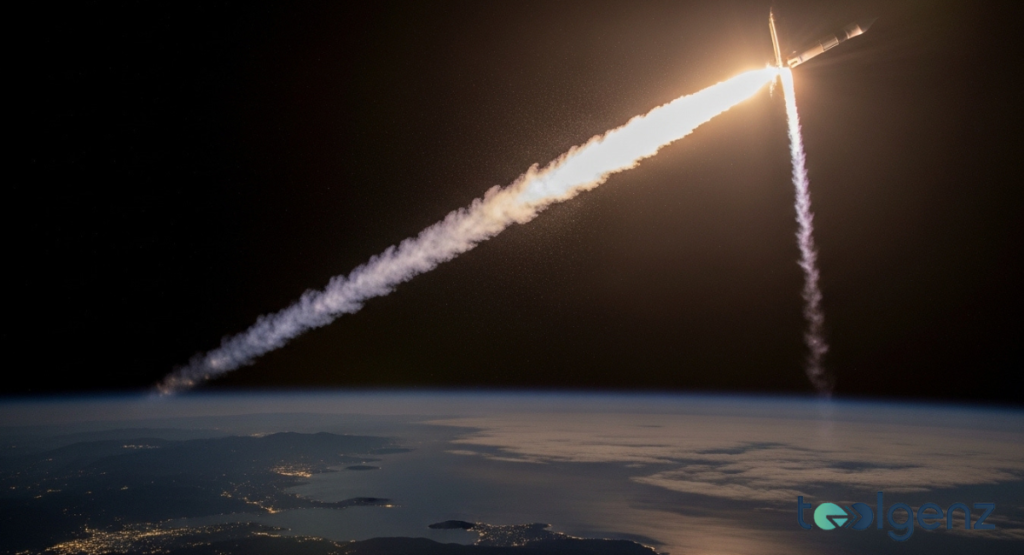
This mission marked the 16th flight of the year from Florida, another sign of how frequently a SpaceX rocket launch now takes place along the Space Coast. Compared to past decades, today’s cadence feels remarkably fast.
The steady rhythm reflects strong demand for satellite deployment, commercial payloads, and government missions. Frequent launches also demonstrate confidence in booster recovery systems and hardware durability, particularly as first stages accumulate multiple flights.
Market Impact: Starlink Growth and $1.75 Trillion Valuation Outlook
Investors often view each SpaceX rocket launch as evidence of operational reliability and expanding revenue potential. The continued growth of Starlink subscriptions provides recurring income, which analysts factor into long-term valuation projections.
Some forecasts suggest that sustained launch success, combined with broadband expansion and future vehicle development, could push the company’s valuation significantly higher over time. Still, competition and regulatory challenges remain part of the broader landscape. Market enthusiasm tends to rise when missions proceed without delay or incident.
Final Thoughts on This SpaceX Rocket Launch
Ultimately, this SpaceX rocket launch combined careful planning, technological precision, and a visual moment that resonated far beyond Florida’s coastline. From liftoff to satellite deployment and booster recovery, the mission demonstrated how modern spaceflight has matured into a consistent and repeatable process.
Yet even with that routine efficiency, early-morning launches continue to inspire awe. The glowing plume over the Atlantic served as a reminder that exploration, innovation, and public fascination can still intersect in a single flight.
FAQS
What time did the mission lift off?
The rocket lifted off at 5:52 a.m. ET during a predawn launch window.
Where did the launch take place?
The mission launched from Cape Canaveral Space Force Station in Florida.
What causes the “space jellyfish” effect?
It happens when sunlight illuminates the rocket’s exhaust plume at high altitude while the ground remains in darkness.
Did the Falcon 9 booster land successfully?
Yes, the first-stage booster landed on the drone ship in the Atlantic Ocean.
What was the purpose of this mission?
The primary goal was to deploy additional Starlink satellites to expand high-speed internet coverage.