

The Artemis 2 mission marks humanity’s first journey beyond Earth in decades, sparking excitement across the United States. NASA is preparing for this historic crewed lunar mission, set to launch on April 1. Astronauts will travel aboard the Orion spacecraft, powered by the Space Launch System rocket, embarking on a journey that tests the limits of human space exploration.
Unlike previous test missions, Artemis 2 will carry humans into deep space, evaluating the systems needed for future Moon landings. This mission is a crucial step in NASA’s lunar program, laying the groundwork for long-term exploration and scientific discovery.
Journey to the Moon ‘Starting to Feel Real’ for NASA’s Artemis 2 Crew
For the Artemis 2 astronauts, the mission is finally becoming real. Years of training and preparation are now coming to life as they get ready to venture beyond Earth. Living away from home for days demands focus, trust, and resilience, and the crew has been rigorously preparing for every scenario.
Their training includes simulations that mirror the conditions of deep space. From emergency drills to piloting the Orion spacecraft, every exercise is designed to prepare them for unexpected challenges. Astronauts Reid Wiseman, Victor Glover, Christina Koch, and Jeremy Hansen have built a strong bond, making teamwork the foundation of their mission’s success.
Final Preparations Underway for NASA’s Moon Mission
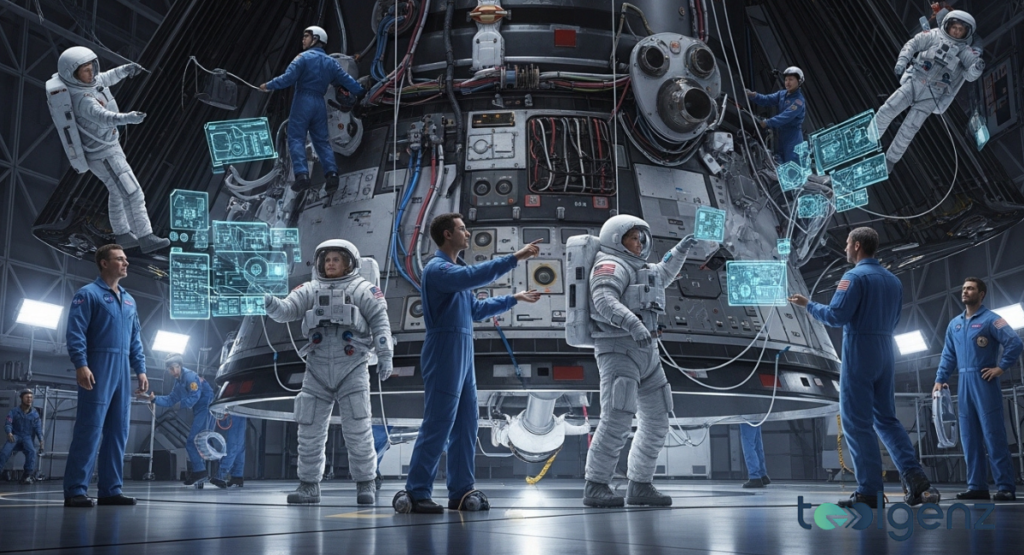
Teams review live telemetry overlays as they prepare for the upcoming lunar flight.
NASA engineers are meticulously reviewing every system ahead of the Artemis 2 launch. Recent flight readiness checks have confirmed that all systems are stable and ready. The SLS rocket is in excellent condition, and no critical concerns are expected to delay progress.
Weather remains a minor factor, with cumulus clouds posing a small risk to the launch. NASA teams remain confident and have built flexibility into the April 1 launch window to accommodate changing conditions.
| Key Element | Status |
|---|---|
| Rocket Systems | Ready |
| Crew Training | Complete |
| Weather Risk | Low |
| Launch Window | Confirmed |
Artemis 2 Crew Arrives at Launch Site, Shares Moon Mascot
When the crew arrived at Kennedy Space Center in Florida, it marked a symbolic step forward in the countdown. The energy at the launch site is palpable, with teams working tirelessly to finalize preparations.
A small Moon mascot accompanies the crew, serving as a reminder that this high-tech mission is also a deeply personal and global journey. It connects people on Earth to the astronauts’ adventure and adds a human touch to an otherwise technical operation.
Mission Overview: What Artemis 2 Aims to Achieve

The team aligns on objectives, timing, and crew roles for the crewed test flight.
Artemis II is designed to test the systems needed for future lunar landings, including life support, navigation, and communication. The spacecraft will follow a lunar flyby trajectory, looping around the Moon in a figure-eight pattern before returning to Earth.
Building on the success of the uncrewed Artemis I mission in 2022, Artemis II takes the next step by carrying humans. It puts NASA’s plans into action and strengthens the overall goals of the Artemis program.
| Feature | Artemis I | Artemis II |
|---|---|---|
| Crew | No | Yes |
| Orbit | Lunar orbit | Flyby |
| Duration | ~25 days | ~10 days |
| Objective | Testing | Human validation |
National Aeronautics and Space Administration’s Role in Artemis Program
NASA’s Exploration Systems Development team leads the Artemis 2 mission, ensuring that every part of the Space Launch System rocket and Orion spacecraft performs flawlessly. Their work is central to the success and safety of the mission.
Collaboration is also a key component. International partners and private companies contribute to the effort, making Artemis II a truly global mission. These partnerships strengthen the program and support long-term plans for a lunar base.
More from Missions: Future Plans Beyond Artemis II

The discussion centers on reusable vehicles and habitats for sustained exploration.
The success of Artemis II will directly influence upcoming missions. Artemis III aims to land astronauts on the Moon, marking humanity’s first lunar landing since the Apollo era.
Looking further ahead, NASA envisions building a permanent presence on the Moon. Artemis II is just the beginning of a larger journey that could eventually lead humans to Mars.
Challenges and Safety Measures for the Moon Mission
Space travel comes with inherent risks, including radiation, isolation, and extreme conditions. Engineers have worked tirelessly to minimize these risks through advanced spacecraft design.
The Orion spacecraft is equipped with multiple safety systems, including backup controls and escape options. Weather remains a consideration, but NASA has carefully planned the launch to balance ambition with safety.
Public Engagement and Global Interest in Artemis II

The scene highlights worldwide interest in returning humans to deep space.
Artemis II has captured the attention of people around the world. Schools, media outlets, and communities are following the mission closely, sparking renewed interest in science and technology.
In the United States, the mission inspires a new generation of space enthusiasts. With the launch window approaching, the excitement surrounding NASA’s lunar program continues to grow, making deep space exploration feel closer and more accessible than ever.
Site Information Navigation and User Experience
A well-organized website improves the user experience when exploring Artemis II news. Categories help readers navigate updates, and “Also Featured In” sections guide users to related topics.
Following NASA’s official channels ensures accurate information, while feedback tools such as “Was this page helpful?” allow visitors to share their input. These features enhance engagement and keep users informed about mission progress.
Artemis 2 Launch Details, Timeline, and Key Facts
The Artemis II launch is scheduled within a flexible window. The mission will last approximately ten days, following a precise lunar flyby trajectory that takes the crew deep into space before safely returning to Earth.
| Key Fact | Detail |
|---|---|
| Mission Duration | ~10 days |
| Crew Members | 4 |
| Rocket | Space Launch System |
| Spacecraft | Orion spacecraft |
| Goal | Test human deep space travel |
This mission is a critical milestone, bridging past achievements with future ambitions. As Artemis II moves closer to launch, it highlights the challenges and excitement of human space exploration. 🚀
FAQS
Will Artemis 2 actually happen?
Yes, Artemis II is planned and moving forward, with NASA actively preparing for its crewed lunar mission.
Is Artemis 2 being delayed?
No major delays have been reported, though minor adjustments could occur due to weather or technical checks.
Is Artemis 2 landing on the moon?
No, Artemis II will perform a lunar flyby and return to Earth without landing.
Will Artemis II have humans?
Yes, this will be the first crewed mission of the Artemis program.
Is Artemis 3 confirmed?
Yes, Artemis III is planned and aims to land astronauts on the Moon following Artemis II’s success.