

In today’s digital world, cybersecurity is evolving fast—and artificial intelligence in cybersecurity is leading that change. As threats grow smarter, companies need tools that think faster.
AI delivers on that promise — automating incident response, spotting threats that haven’t been seen before, and analyzing user behavior to catch anything out of the ordinary.
From AI-powered threat detection to real-time defense, the power of AI is transforming how organizations stay protected. Learn more in our Artificial Intelligence 2025 Ultimate Guide.
However, with great power comes great risk. AI can also be used by hackers for cyberattacks fueled by AI, creating a complex security landscape.
This guide explores the full impact—good and bad—of AI on cybersecurity today and in the future.
We’ll uncover how AI strengthens security, where it falls short, and what’s coming next. Whether you’re a business leader or a tech enthusiast, this complete guide will help you understand AI’s role in protecting digital assets in an increasingly hostile cyber world.
A New Weapon for Attackers: How AI Is Shaping Cyberattacks
Attackers also use AI. This is what makes cyberattacks fueled by AI so dangerous. These threats are smarter and harder to detect.
Tools like deepfake cyberattacks use AI to fake voices or images. Hackers can fool even trained professionals. Another serious risk is data poisoning attacks, which corrupt AI models during training.
AI also helps attackers launch complex AI-based phishing detection evasion schemes. These phishing attempts change rapidly and trick even advanced filters.
AI as a cybersecurity weapon is a real and growing threat. It’s now part of the arms race between hackers and defenders.
Security experts must now think like attackers and use AI to stay one step ahead. The challenge is no longer just detecting threats, but predicting and preventing them before they strike. As both sides adopt smarter tools, the battle over cyberspace continues to escalate.
Benefits of AI in Security
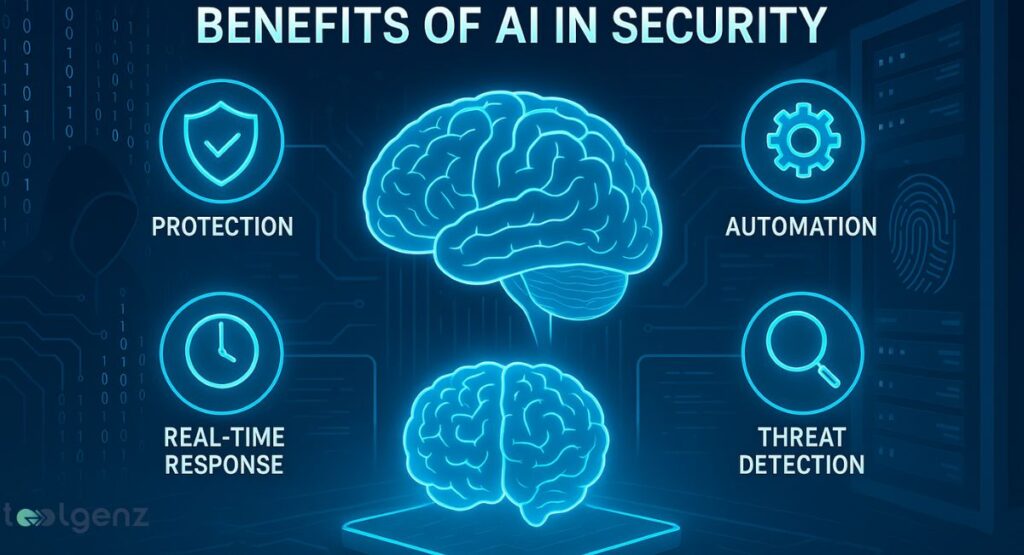
Improving cybersecurity with AI gives many advantages. By processing data faster than any human could and minimizing errors, AI offers stronger protection while reducing the workload for security teams.
AI systems can automate incident response and act in real-time. They can spot threats as they happen and respond within seconds, often stopping attacks before any damage occurs.
With continuous learning, AI systems become smarter over time, adapting to new types of threats and unusual patterns. This makes them a powerful ally in maintaining strong and reliable cyber defenses.
Top Benefits
| Benefit | Description |
| Real-time threat mitigation | Stops attacks as they happen |
| Automated cybersecurity | Handles tasks without delay |
| Analyzing user behavior with AI | Spots strange activity quickly |
| Security orchestration with AI | Connects different tools for better defense |
| AI-driven compliance governance | Keeps systems within legal rules |
Challenges of Implementing AI in Security
Still, using AI in security isn’t easy. One major challenge is bias in AI training data. If an AI system is trained with poor data, it can make mistakes. These errors could leave systems open to attacks.
Another issue is understanding AI decisions. Many models are hard to explain. Data privacy and AI ethics are becoming bigger concerns. Any AI solution must follow regulations like GDPR, and misuse could quickly lead to legal issues.
There’s also the cost of building and running AI models. Organizations must carefully plan before deploying AI tools.
They need skilled teams, ethical frameworks, and strong testing methods to avoid unexpected failures or risks, read NIST’s AI Risk Management Framework.
Use Cases of Artificial Intelligence in Security
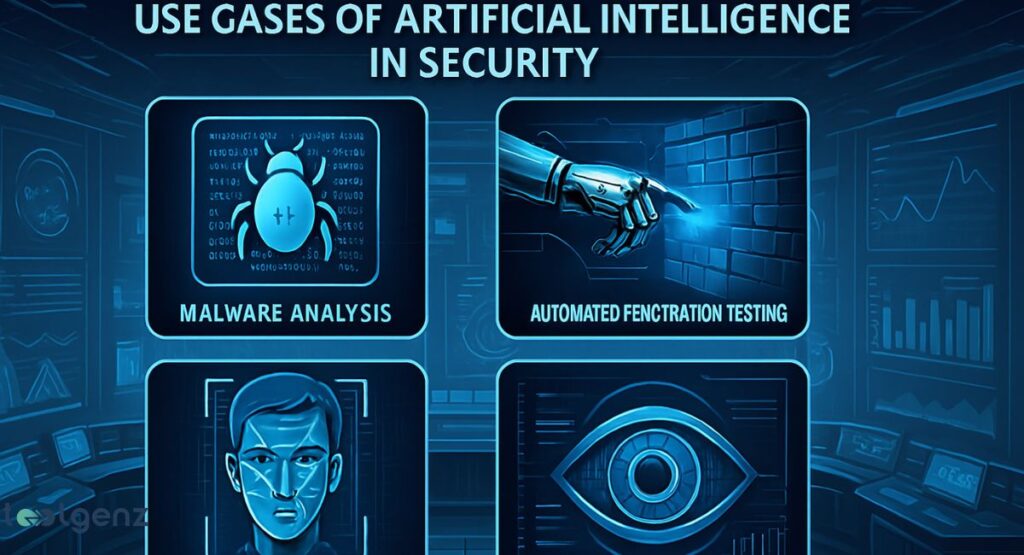
AI is used in many areas of security. One major use is AI-enhanced malware detection. AI can identify new viruses even if they’ve never been seen before.
AI is also used in penetration testing, allowing systems to simulate attacks and find weaknesses before hackers do. It’s even applied in facial recognition to spot unauthorized or suspicious access attempts.
AI-powered data mapping also helps with tracking sensitive information. It shows where data is stored and who can access it. This is useful for AI in data protection. AI spots fake or unauthorized access.
These examples show how AI can protect networks, devices, and data at multiple levels. It brings more speed, accuracy, and depth to cyber threat management than traditional tools ever could.
Best Practices for Implementing AI in Security
If you’re adding AI to your security setup, follow these best practices. First, train your models on good data. Avoid machine learning vulnerabilities by checking training sets.
Keep a human in the loop to oversee AI decisions, and choose security tools that update regularly so they can keep up with new threats. These tools should work well with your current security platform.
Don’t forget to focus on ethical AI use. This builds trust with your users and keeps your company safe from misuse claims.
Also, keep your team educated on new AI trends and risks. Regular audits and testing will help maintain system performance.
With the right approach, AI can strengthen your entire cybersecurity strategy.
AI-Powered Security Solutions and Intelligent Assistants
Many AI-driven security tools help automate defenses. These tools offer features like automation of security tasks and fast data analysis. Intelligent assistants also help security teams make better decisions.
Tools like infinity AI Copilot act as smart helpers for threat response. AI-powered threat detection systems now come with NLP for security analytics. They understand written reports and emails to detect threats.
These tools also aid in automating incident response. They lower risk and reduce the need for large teams. As cyber threats grow, these smart tools are becoming essential. They help companies stay ahead of attackers, adapt quickly, and respond in real-time to new threats.
Latest Product Demonstrations
In 2025, several vendors have shown exciting demos of security automation platforms. For example, IBM’s Watson X showcased AI-enhanced intrusion detection.
Palo Alto Networks launched a new tool that uses AI-powered data mapping and real-time threat mitigation in hybrid environments.
CrowdStrike also revealed upgrades to its Falcon system. The update includes AI and regulatory compliance features. These demos show how companies use AI to stay ahead of hackers.
These innovations show that AI-powered hybrid cloud security isn’t just an idea for the future — it’s already in action today. These tools help security teams act faster, reduce risks, and meet strict compliance needs with less effort.
Case Studies: Real-World Applications of AI in Cybersecurity

In one U.S. case, a major hospital used cyber defense automation after a ransomware attack. With AI, they identified the source quickly. The system used threat intelligence with AI to block the attacker’s IP.
Another case is from a bank in California. They used AI in identity and access management to detect fake logins. The AI blocked over 10,000 suspicious attempts in a month.
These examples highlight that AI in cybersecurity has moved beyond being a trend — it’s now a vital part of staying secure.
As threats grow more complex, these real-world examples show the power of AI to stop attacks before they spread.
More companies are now exploring AI-driven compliance governance and automated cybersecurity to protect their networks.
The Future of AI in Security
The future of AI in cybersecurity is full of promise. With better data and tools, AI will become smarter. Expect stronger AI-enhanced intrusion detection, faster response, and smarter threat prediction.
We’ll also see more generative AI in cyber defense for proactive protection. Experts also believe AI-powered threat detection will become part of all major security platforms.
More companies will invest in AI-driven compliance governance.
AI won’t replace humans, but it will make them more powerful. As regulations evolve and cyber risks grow, AI will play a central role in adaptive defense strategies.
Organizations that adopt AI early will gain a critical edge in the cybersecurity landscape of tomorrow.
FAQs
- Which AI is used for cybersecurity?
Machine learning, deep learning, and natural language processing (NLP) are widely used AI types in cybersecurity for threat detection and response. - What is the impact of artificial intelligence on cybersecurity?
AI improves threat detection, speeds up response, and reduces human error—but it can also be exploited by attackers. - What are the 4 types of artificial intelligence?
Reactive machines, limited memory, theory of mind, and self-aware AI. - Is AI necessary for cybersecurity?
Yes, AI is increasingly essential to combat evolving cyber threats and automate complex security tasks. - What are the 3 pillars of cybersecurity?
Confidentiality, Integrity, and Availability (CIA Triad).