
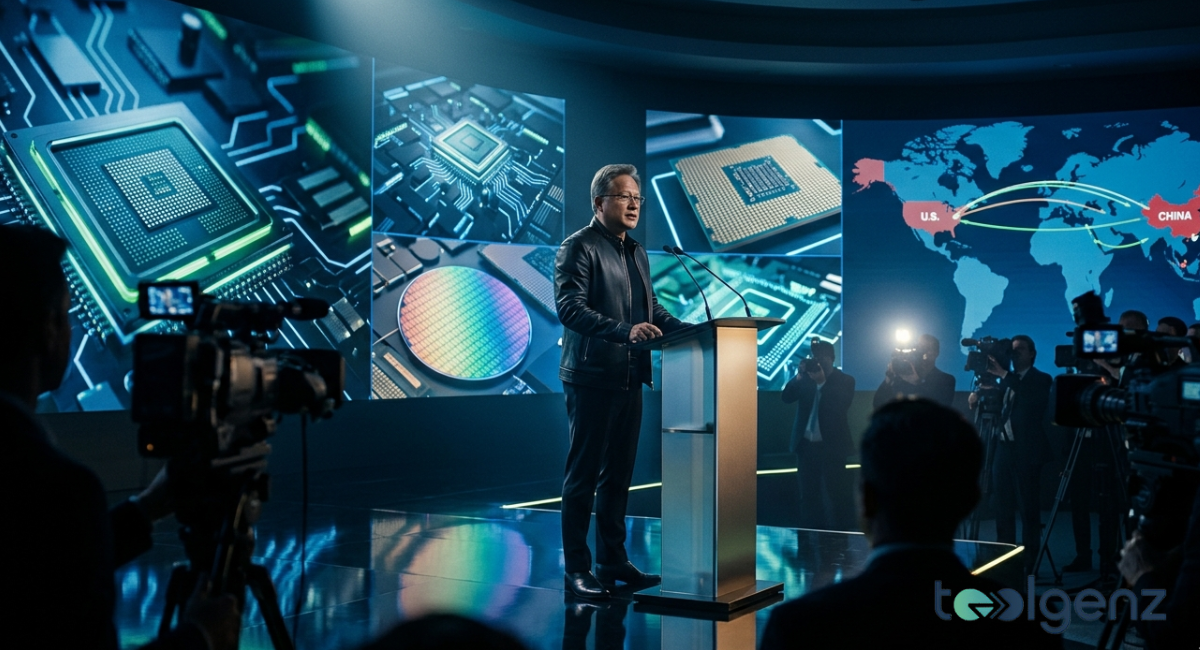
Why Jensen Huang’s Comments on China Sparked Controversy
Few figures in the global tech industry attract as much attention as Jensen Huang. As Nvidia’s co-founder and CEO, he has become one of the most influential voices in the AI revolution. His recent remarks on selling advanced chips to China quickly ignited debate across Washington, Silicon Valley, and global markets.
What made the comments controversial was not just the business angle, but the timing. As tensions rise between the U.S. and China over advanced technology, Jensen Huang positioned himself in the middle of a sensitive geopolitical conversation.
At the center of the debate is a difficult question: should American companies continue selling cutting-edge AI chips to China, or should restrictions tighten further to protect national security?
For Jensen Huang, the issue is not black and white. It is a balancing act between maintaining global competitiveness and navigating political pressure that is reshaping the semiconductor industry.
Nvidia’s Business in China: How Important Is It?
China remains one of Nvidia’s most important markets. It contributes significantly to revenue and plays a key role in the company’s global expansion strategy. For Jensen Huang, China is not just another market—it is a major driver of scale for AI adoption.
Nvidia’s growth depends heavily on widespread use of its GPUs in data centers, research labs, and enterprise systems. China’s fast-growing AI ecosystem has been a key part of that expansion.
However, the situation is becoming more complicated. As China continues to invest heavily in domestic semiconductor capabilities, competition is increasing. At the same time, Jensen Huang has acknowledged that limiting access too aggressively could push China to accelerate its own chip development.
This creates a delicate tension between short-term revenue and long-term strategic positioning.
U.S. Restrictions and Their Impact on Nvidia
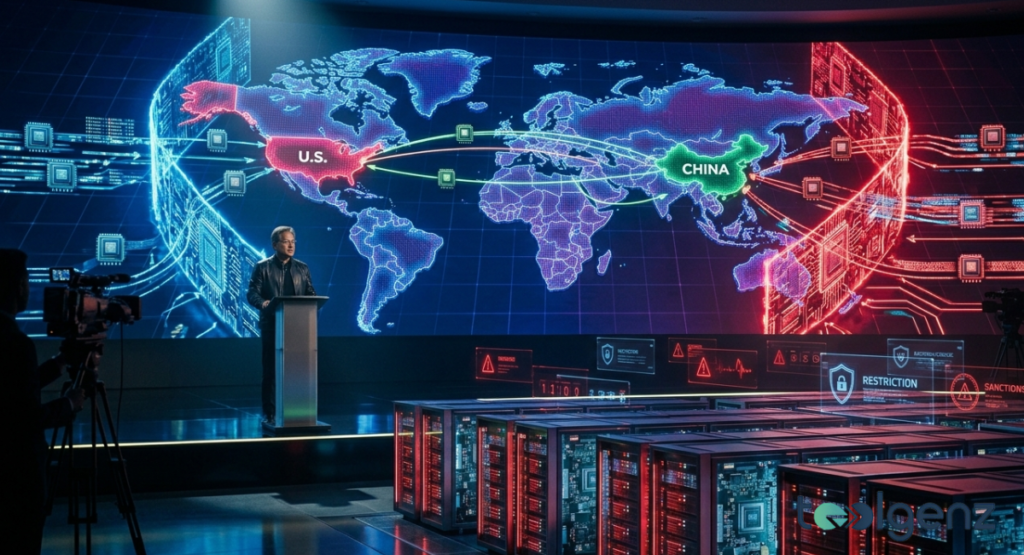
Export controls reshape which chips can ship and where data centers grow.
Over the past few years, the U.S. government has introduced stricter export controls on advanced semiconductors. These regulations are designed to limit China’s access to high-performance AI chips used in military and advanced computing applications.
For Nvidia, this has created operational challenges. Products must often be redesigned to meet compliance requirements, which slows down development cycles and complicates global distribution.
Jensen Huang has publicly addressed these challenges, emphasizing that regulations are reshaping how companies like Nvidia operate on a global scale.
The broader concern is that while these rules aim to protect U.S. technological leadership, they may also fragment the global semiconductor ecosystem. Jensen Huang has warned that overly restrictive policies could reduce American influence in global AI development over time.
Jensen Huang’s Defense: ‘We Should Be Selling Chips to China’
One of the most discussed moments came when Jensen Huang made his position clear: he believes continued engagement with China is strategically important.
His argument is based on a simple idea—if American companies remain active in China, they can maintain influence over global AI infrastructure. Cutting off access entirely, he suggested, could have unintended consequences.
According to Jensen Huang, staying connected to China’s AI ecosystem helps reinforce U.S. technological leadership rather than weaken it. If China is forced to build entirely independent systems, the competitive balance could shift faster than expected.
He also emphasized that innovation thrives in interconnected markets. In his view, complete separation could slow down global progress in AI development.
Market Reaction: Nvidia Stock and Investor Sentiment
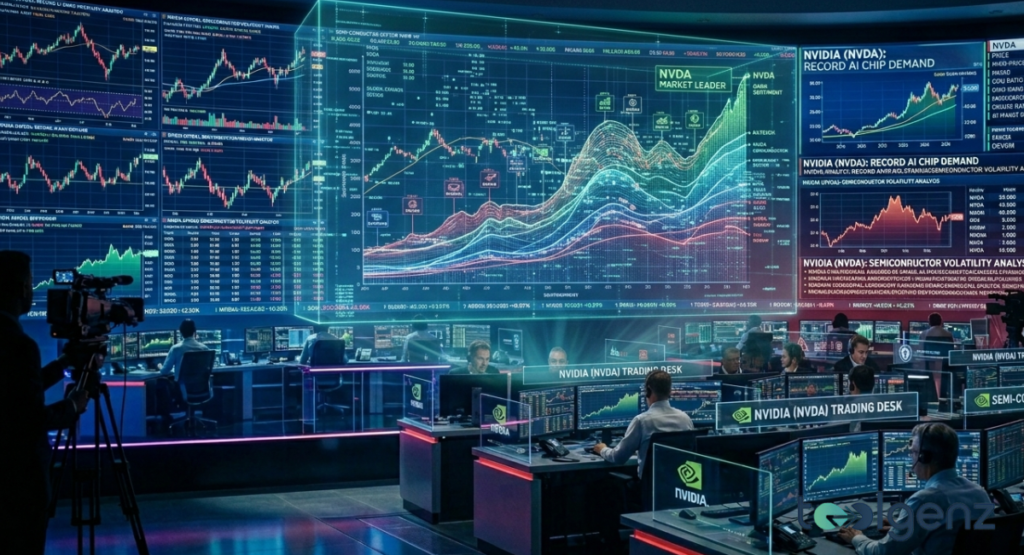
AI demand drives highs while regulatory risk injects volatility.
Financial markets reacted quickly to the remarks made by Jensen Huang. NVidia’s stock has long been sensitive to news related to China and U.S. export policy, and this situation was no different.
Some investors viewed his comments as pragmatic, believing that continued access to China supports long-term growth in AI demand. Others were more cautious, pointing to rising geopolitical risks and regulatory uncertainty.
Despite short-term volatility, confidence in Nvidia’s underlying business remains strong. Demand for AI computing power continues to rise globally, supporting optimism among many analysts.
For Jensen Huang, market reactions are part of a broader cycle shaped by policy shifts rather than fundamental weakness in demand.
Wall Street Outlook: Price Targets and Blackwell Expectations
Wall Street analysts remain largely optimistic about Nvidia’s future. Much of this confidence is tied to the next generation of AI chips, including the upcoming Blackwell architecture.
Many forecasts suggest continued growth driven by expanding data center demand and accelerating AI adoption across industries.
Analysts believe Nvidia’s leadership in high-performance computing will remain a key advantage, even as competition intensifies. Jensen Huang has repeatedly highlighted that AI infrastructure is still in its early stages of expansion.
Investor attention is now focused on whether Nvidia can maintain its growth trajectory amid tightening global regulations.
Key Bear Arguments Against Nvidia — and Huang’s Response
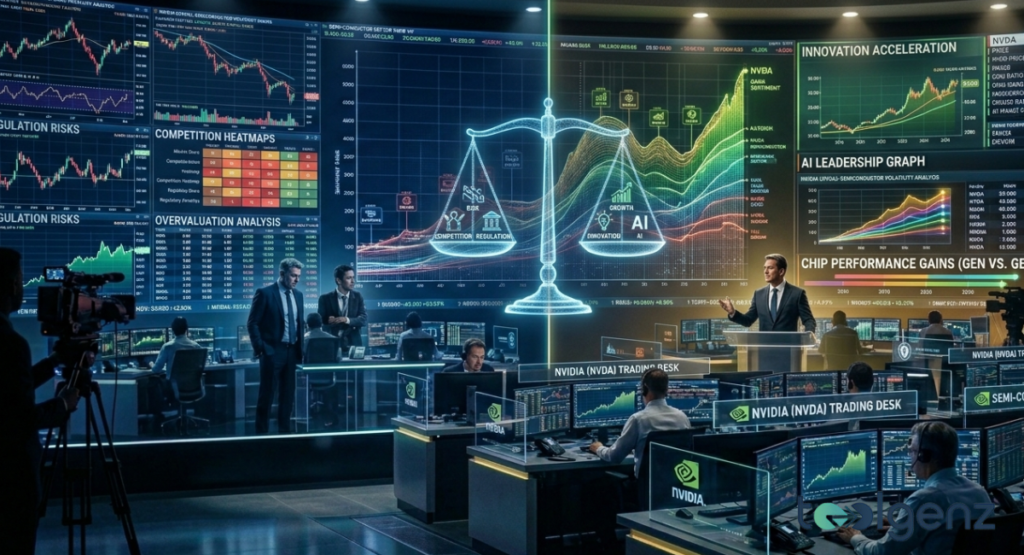
Critics cite valuation and competition; bulls point to performance moats.
Not all analysts share the same optimism. Some critics argue that Nvidia’s valuation has grown too quickly and may not be sustainable.
Concerns include rising competition, particularly from companies developing alternative AI chips, and potential limits on international sales.
However, Jensen Huang has consistently pushed back against these concerns. He points to sustained demand for AI infrastructure and the increasing importance of accelerated computing in nearly every major industry.
In his view, the long-term growth story remains intact, even if short-term volatility continues.
Competition Heats Up: AMD, China’s Domestic Chip Push
Competition in the semiconductor space is intensifying rapidly. Companies like AMD are advancing their AI chip capabilities, while China is investing heavily in domestic alternatives.
This shift is reshaping global supply chains and increasing competitive pressure on Nvidia. For Jensen Huang, this evolving landscape is both a challenge and a validation of how important AI computing has become.
China’s push for self-reliance in semiconductors adds another layer of complexity. While it may reduce dependence on U.S. technology, it also accelerates innovation across the industry.
Nvidia now operates in a more competitive and politically sensitive environment than ever before.
Nvidia’s Core Business Explained: ‘Turning Electrons Into Tokens’
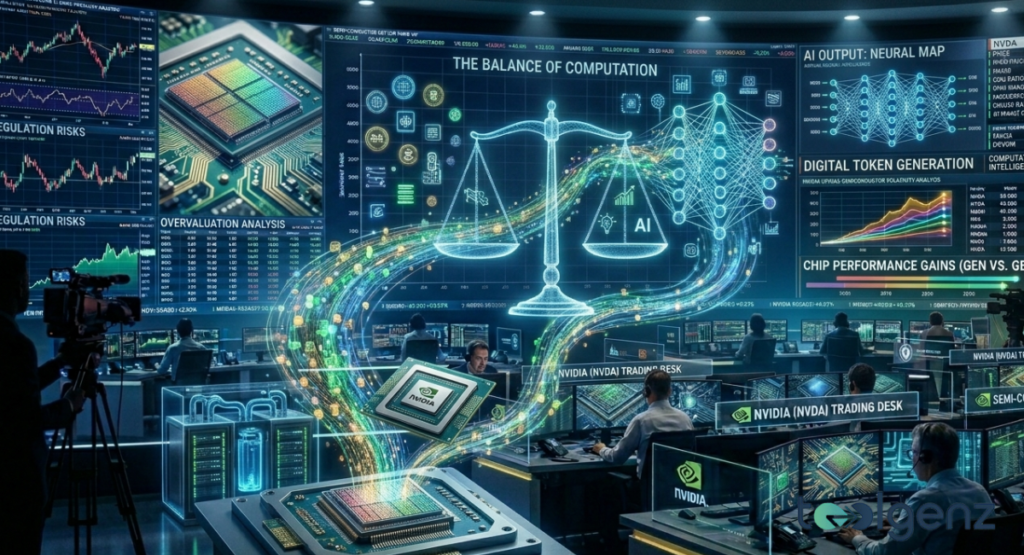
Silicon, software, and systems combine to produce AI at scale.
One of the most quoted explanations from Jensen Huang describes Nvidia’s mission in simple terms: turning electrons into tokens.
What he means is that Nvidia’s chips transform raw electrical energy into meaningful computational output—essentially powering AI systems that generate text, images, and predictions.
At its core, Nvidia specializes in high-performance GPU computing. This technology enables large-scale AI models to process massive amounts of data efficiently.
Jensen Huang often emphasizes that this transformation is what makes modern AI possible. Without accelerated computing, today’s AI breakthroughs would not be feasible at the same scale.
The One Number That Could Decide Nvidia’s Future
Among all financial metrics, data center revenue stands out as the most important indicator of Nvidia’s future performance.
This segment reflects global demand for AI infrastructure, cloud computing, and enterprise-scale machine learning systems.
For Jensen Huang, data centers represent the foundation of the AI economy. Growth in this area signals continued adoption of Nvidia’s technology across industries.
Analysts closely watch this metric because it captures both opportunity and risk. Strong demand suggests expansion, while regulatory changes could quickly impact future growth.
Final Take — What Jensen Huang’s Strategy Means for the U.S. Tech Future

Leadership in AI hardware will decide economic and geopolitical influence.
The debate surrounding Jensen Huang goes far beyond Nvidia as a company. It reflects a larger shift in global technology power dynamics, particularly between the United States and China.
As AI becomes increasingly central to economic and national security strategies, decisions made today will shape the future of the industry for decades.
For Jensen Huang, the challenge lies in balancing innovation, global access, and regulatory pressure—all at the same time.
His approach reflects a broader reality: AI is no longer just a technological race, but a geopolitical one.
How companies navigate this environment will determine not only their success, but also the direction of global AI development in the years ahead.
FAQS
Why does Jensen Huang only own 3% of Nvidia?
Jensen Huang owns about 3% because Nvidia is a publicly traded company, and ownership has diluted over time through stock issuance, investors, and employee equity grants.
Is Jensen Huang a US citizen?
Yes, Jensen Huang is a U.S. citizen; he was born in Taiwan and later moved to the United States, where he built his career.
At what age did Jensen Huang start Nvidia?
Jensen Huang co-founded Nvidia in 1993 at the age of 30.
How rich is the CEO of Nvidia?
Jensen Huang has a net worth estimated in the tens of billions of dollars, largely tied to his Nvidia stock holdings.
Are 70% of Nvidia employees millionaires?
While not officially confirmed, many early and long-term Nvidia employees became millionaires due to stock compensation and the company’s massive growth.