

Samsung’s latest earnings surprise has shaken Wall Street, creating confusion across the tech sector. Despite record-breaking profits, investors reacted with caution, triggering a sharp memory stocks selloff that pulled down major players. This unexpected disconnect underscores a deeper anxiety running through the chip sector: that the massive wave of AI infrastructure spending may finally be cooling off.
While strong results were driven by an ongoing AI chip demand surge, analysts worry about sustainability and pricing pressure. The situation reflects rising chip industry volatility, especially after a long rally. For U.S. investors, understanding this Samsung earnings impact is crucial to navigate risks and opportunities in the evolving semiconductor landscape.
All eyes are now on how rival chipmakers manage their production lines. If factories pump out too much supply as pricing power begins to soften, things could get bumpy for these stocks heading into winter. This moment serves as a key turning point, where strong earnings alone may no longer guarantee positive market reactions.
Why Samsung’s Strong Results Triggered a Memory Stock Selloff
At first glance, strong earnings should boost confidence. Yet the memory stocks selloff started because valuations were stretched. Investors feared that memory chip pricing power may not hold as supply increases. Even with strong demand, expectations had already priced in perfection.
Another factor is chip industry volatility. The market often moves ahead of real data. Instead of reassuring Wall Street, Samsung’s blockbuster numbers acted as a pressure valve for a broader correction, proving just how fragile investor sentiment has become.
It’s also a classic case of profit-taking. Big institutional funds are locking in gains after a massive run-up, while short-term momentum traders flee at the first sign of a cooling trend. As a result, even positive fundamentals can lead to declines when market expectations are too high.
Micron, SanDisk, and Western Digital Drop 7% After Samsung News
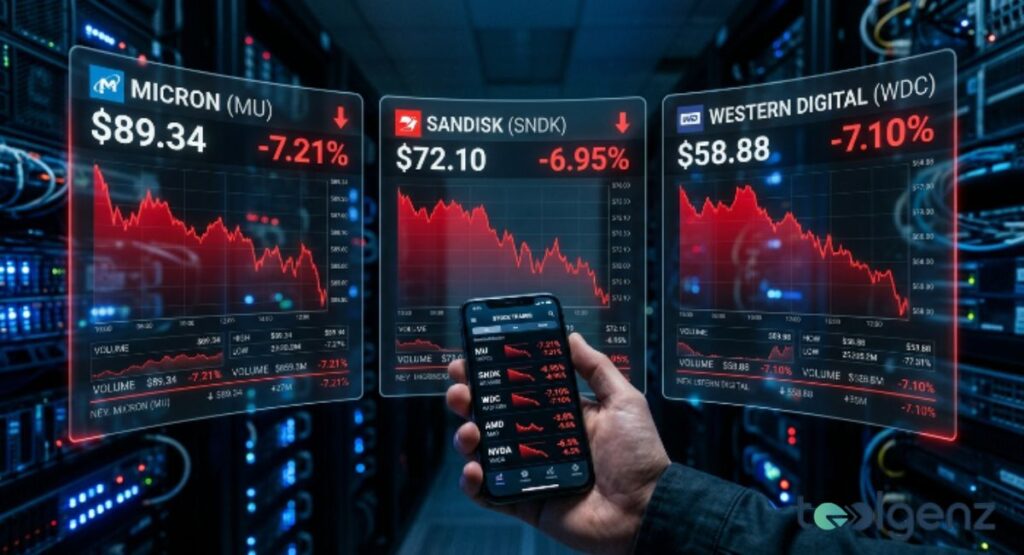
Contagion spreads quickly through MU, SNDK, and WDC tickers.
The reaction spread quickly across U.S. companies. Micron Technology bore the brunt of the immediate sell-off, dropping sharply as sentiment shifted overnight. Storage giants SanDisk and Western Digital quickly followed suit, dragging down the broader data storage sector as investors suddenly questioned future hardware demand.
This selloff reflects strong sector correlation. Even Seagate Technology dropped, affecting its broader market position and driving down tech shares. The table below shows how major stocks reacted:
| Company | Reaction After Samsung News | Key Concern |
| Micron | Sharp Drop | Micron stock prediction uncertainty |
| SanDisk | Decline | Weak SanDisk stock performance |
| Western Digital | Drop | Slowing storage demand fears |
| Seagate | Negative Move | Pressure on HDD market |
How SK Hynix and Other Memory Stocks Slipped Into Bear Market Territory
The global effect became clear fast. SK Hynix experienced heavy losses, worsening SK Hynix stock performance. Many analysts now warn of a memory chip industry bear market forming after months of rapid gains.
This decline ties to DRAM and NAND market trends. Prices surged earlier, but now investors fear a slowdown. The Samsung earnings shock exposed risks in the global chip supply chain. When supply rises faster than demand, stocks often fall sharply.
At the same time, rising competition among major chipmakers is adding pressure on margins. Investors are also watching inventory levels closely, as higher stockpiles could signal weakening demand ahead. These combined factors are increasing uncertainty and making the near-term outlook for memory stocks more cautious.
Peers Follow the Decline After a Historic Rally in Memory Stocks

The domino effect wipes out gains as “Bubble Burst” chips collapse.
Before this drop, memory stocks enjoyed huge gains. The memory supercycle trend pushed valuations higher. However, such rallies often lead to corrections. The current decline reflects profit-taking in semiconductor stocks after strong runs.
Funds like the Roundhill Memory ETF DRAM also showed weakness. This confirms a sector-wide pullback. The Samsung earnings shock didn’t create the problem. It simply exposed existing risks in chip stocks year-to-date gains.
Moreover, many investors are now reassessing their positions after the rapid surge in prices. When markets move too fast, even strong sectors need time to stabilize and reset expectations. This phase could act as a cooling period before the next potential growth cycle begins.
What Samsung’s Earnings Mean for Taiwan Semiconductor and the Chip Sector
The ripple effects reached Taiwan Semiconductor Manufacturing Company. As a leader in advanced chips, TSMC depends on stable demand. The AI-driven demand for chips still supports long-term growth, but short-term uncertainty remains.
Analysts at UBS and Bank of America are already urging caution, warning that the eye-popping profit margins chipmakers enjoyed over the last year may not be sustainable. The Samsung earnings shock may force companies to rethink pricing and production strategies across the global chip supply chain.
At the same time, any adjustment in production plans could impact future supply levels and pricing trends. Investors are closely monitoring how TSMC and other major players balance growth with cost control. These decisions will likely shape the next phase of recovery or further volatility in the semiconductor market.
Key Reasons Behind the Sudden Shift in Investor Sentiment

The analyst’s desk becomes a hub for parsing conflicting market signals.
Investor psychology changed quickly. The market moved from optimism to caution due to stock market volatility tech sector patterns. Even strong earnings could not stop fear of slowing growth.
Another reason is valuation pressure. Many stocks were priced for perfect growth. The semiconductor AI trade valuation became stretched. When reality fell short, selling followed. This explains the speed of the semiconductor earnings reaction.
In addition, rapid shifts in sentiment often trigger algorithmic trading and large fund movements, which can accelerate declines. Investors are now more sensitive to even minor changes in forecasts or guidance. This environment makes the market more reactive, where expectations matter as much as actual performance.
Is This a Short-Term Correction or the Start of a Downtrend?
Some analysts see this as a healthy pause. A chip stock market correction can reset valuations and create better entry points. The Samsung earnings shock may only mark a temporary slowdown in momentum.
Others warn of deeper risks. Concerns about memory chip supply bottleneck 2027 and changing demand patterns remain. The future depends on how companies handle supply and maintain global memory chip demand outlook stability.
In the near term, market direction will likely depend on upcoming earnings reports and forward guidance from major chipmakers. If demand continues to hold steady, confidence could return quickly. However, any signs of weakening orders may extend the cautious sentiment across the sector.
The Bull Case for Memory Stocks — Why Growth May Continue

Green charts and a charging bull signal growth may resume.
Despite the selloff, strong growth drivers remain. The AI infrastructure and chip demand continues to rise rapidly. Data centers and cloud computing fuel long-term expansion in the data storage industry growth.
The structural demand for AI infrastructure isn’t vanishing overnight. This pullback looks less like a structural collapse and more like a necessary reality check, resetting sky-high expectations before the next expansion cycle takes hold.
As investment in artificial intelligence accelerates, chipmakers are likely to benefit from sustained enterprise and hyperscaler spending. This could help stabilize pricing and restore investor confidence over time. Ultimately, long-term fundamentals still point toward continued innovation and expansion across the semiconductor ecosystem.
Future Outlook for Memory Stocks in 2026 and Beyond
Looking ahead, the semiconductor sector outlook remains promising. Forecasts like Micron Q4 2026 revenue guidance suggest continued demand growth. However, investors must prepare for ongoing chip industry volatility.
The future will depend on balance. If supply aligns with demand, memory chip pricing power will recover. The Samsung earnings shock will then be remembered as a turning point, not a collapse, in the evolving memory market cycle.
As the industry enters a new phase, companies that manage innovation, supply planning, and customer demand will likely gain a stronger position. Investors will continue watching AI expansion, production capacity, and market trends closely. These factors will shape the next chapter of memory stocks and the broader semiconductor landscape.
FAQS
Does Samsung have a US stock?
Samsung does not have a major U.S.-listed stock, but investors can buy its Electronics shares through the Korean exchange or ADR options.
Is Samsung a good stock to buy?
The company can be attractive due to its semiconductor and AI growth potential, but investors should consider market risks and valuation.
Why is Samsung stock falling?
The stock is falling due to profit-taking, concerns about chip demand, and worries about future semiconductor growth.
Does Samsung have its own stock?
Yes, the company has its own publicly traded shares listed on the Korea Exchange.
Can US citizens invest in Samsung stock?
Yes, U.S. citizens can invest through international brokerage accounts or platforms that provide access to Korean stocks.