
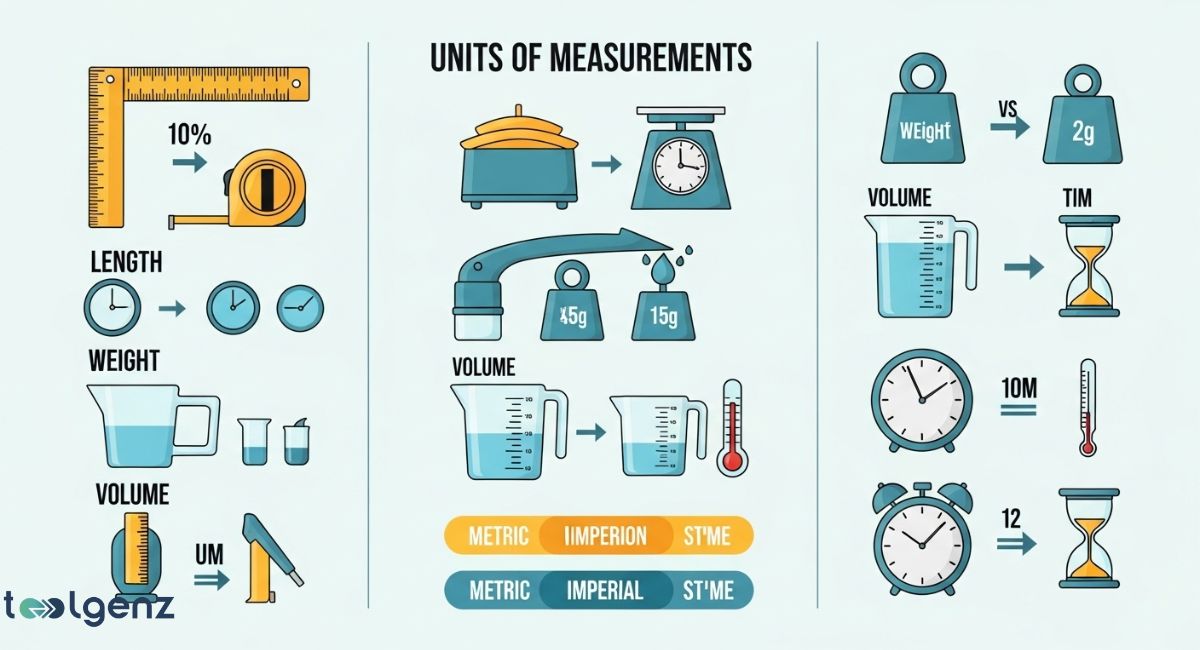
Understanding units of measurement is essential in science, engineering, cooking, and everyday life. From checking a recipe to building a bridge, accurate measurements ensure precision and safety.
Over time, humanity has developed different systems like the metric system and imperial system, each with its own history and usage.
Today, global trade, travel, and technology rely on conversions between these systems to avoid costly mistakes.
Whether you’re trying to convert weights, understand base units, or make sense of prefixes like kilo or milli, this guide will walk you through measurement in a way that feels simple and practical.
Let’s explore their origins, differences, and how to convert them easily.
In the sections ahead, we’ll uncover fascinating historical facts, explore practical conversion methods, and highlight modern tools that make the process easier.
By the end, you’ll not only understand these systems but also know how to apply them confidently in real-life situations.
The History of the Pound and Other Traditional Units
The pound history goes back to ancient Rome. Over time, it evolved into different standards like the avoirdupois system used for most goods today, and the troy system used for precious metals.
Each version had a different weight, which caused confusion in early trade.
In the USA, the avoirdupois pound became standard after influence from Britain.
However, historical units like the long ton, short ton, stone, and ounce still appear in trade, shipping, and recipes. Understanding them is important for accurate weight conversion.
Knowing how these systems developed helps us see how much they’ve shaped trade, culture, and even everyday life.
These variations also reveal how measurement shaped economic relationships and global trade practices over centuries.
For readers who want to explore how modern standards continue to evolve, the official resource on NIST measurement standards offers comprehensive insights into global measurement practices and why consistency remains vital.
The Evolution of the Metric System
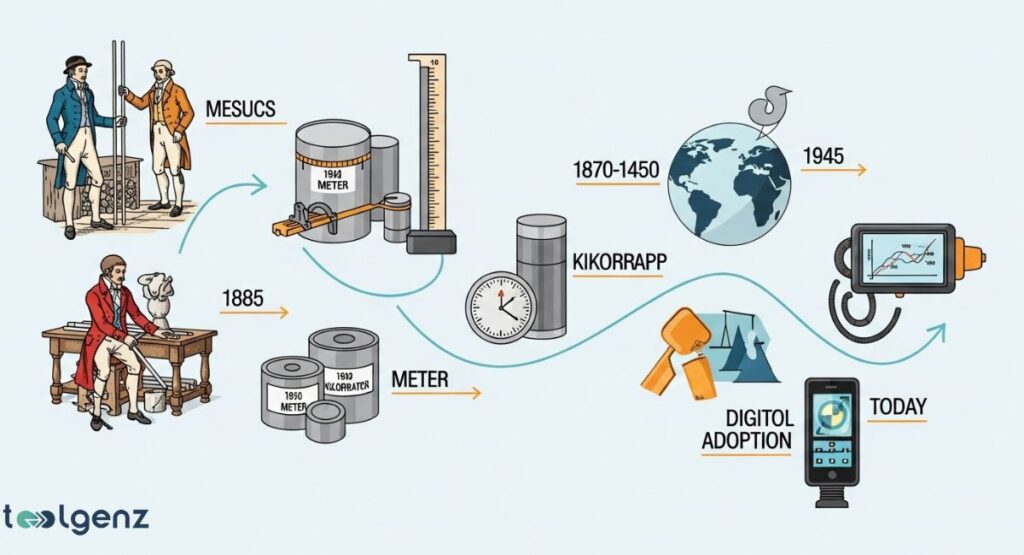
The metric system began during the French Revolution to unify measurements.
Early thinkers like John Wilkins and Gabriel Mouton wanted a system based on natural constants instead of arbitrary local standards. Charles Maurice de Talleyrand-Périgord promoted its use across Europe.
Later, leaders like Napoleon expanded the metric system, but the USA largely kept the imperial system for public use.
Because the metric system uses simple decimal steps — kilo, centi, milli — calculations became much easier, which is why scientists and engineers quickly embraced it.
Over time, the metric system became the foundation for the International System of Units (SI), ensuring uniformity worldwide.
Its adoption continues to influence education, trade, and global communication in modern society.
The International System of Units (SI)
The International System of Units (SI) is the modern form of the metric. It has seven base units for length, mass, time, electric current, temperature, amount of substance, and luminous intensity.
From these, many derived units like joule, watt, pascal, hertz, and newton are created.
The kilogram definition once depended on the platinum-iridium cylinder, but now is set using Planck’s constant.
The meter definition is tied to light speed, and the second is based on the cesium atom’s vibration. This ensures scientific measurement accuracy worldwide.
This level of precision means that scientists and engineers around the world can work with the same standards without confusion.
The SI also evolves with new discoveries, making it a living standard that adapts to modern technological needs.
Metric vs Imperial (American) Measurements
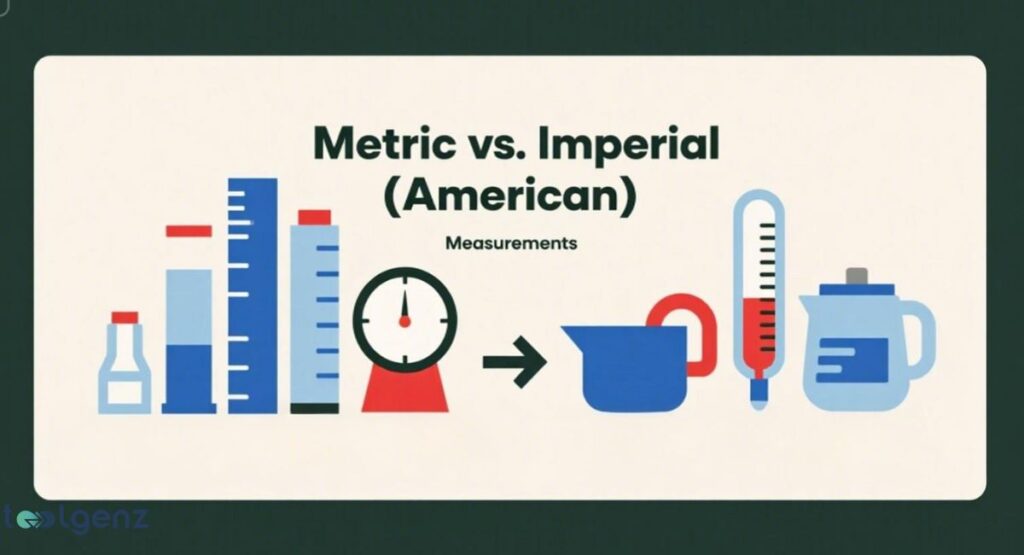
The metric vs imperial debate continues in the USA. The metric system is used in medicine, science, and global trade, while the imperial system is used for road signs, groceries, and construction.
This mix can get confusing — especially if you’re a student learning conversions, a traveler abroad, or a business working across borders.
While some push for full metric adoption, cultural habits and historical familiarity keep the imperial system alive in everyday American life.
Common Conversions Table
| Imperial | Metric |
| 1 inch | 2.54 cm |
| 1 foot | 0.3048 m |
| 1 mile | 1.609 km |
| 1 pound | 0.4536 kg |
| 1 gallon | 3.785 L |
Knowing both helps avoid errors when switching between systems.
Common Causes of Measurement Confusion
Measurement mix-ups often happen when people mix historical measurements with modern units. For example, the UK gallon is larger than the US gallon, leading to fuel trade misunderstandings.
Big mistakes happen when conversion factors are ignored. NASA once lost a Mars probe due to a metric-imperial mismatch.
In cooking, even a small conversion mistake can ruin a recipe — which is why online unit converter tools are so useful.
Such errors highlight the importance of double-checking figures before using them, whether in engineering projects, lab experiments, or everyday tasks.
Even small discrepancies can have huge financial or safety consequences when scaling up measurements.
How to Convert Between Units Easily

Converting length, temperature, or volume might seem tricky at first, but once you know the right steps, it becomes much easier.
Start by knowing the correct factor, then multiply or divide. For example, to convert pounds to kilograms, multiply by 0.4536.
Many prefer using a conversion calculator to avoid mistakes. Others memorize simple rules, like subtracting 32 and multiplying by 5/9 to go from Fahrenheit to Celsius. Engineers often keep printed charts for quick checks.
In large-scale industries, automated software handles thousands of conversions in seconds, reducing human error.
Still, understanding the process yourself ensures you can verify results when tools aren’t available or when accuracy is critical.
Interactive Unit Converter Tools
Online converters save time. A cooking unit converter makes recipe adjustments simple.
A fuel consumption converter helps compare miles per gallon with liters per 100 km. Industry tools handle exotic units used in physics or engineering.
Good converters include options for scientific measurement accuracy, letting you choose decimal precision. Many tools also cover Gaussian units for specialized science work.
Many modern converters save your recent calculations or connect with mobile apps, so you can check conversions quickly while you’re on the move.
This makes them valuable not only for students and professionals but also for travelers, traders, and hobbyists working across measurement systems.
Expanding Your Conversions: Other Magnitudes and Measurements

Beyond length, weight, and volume, there are measures for energy, power, and pressure.
Units like the joule, watt, pascal, hertz, and newton are standard in science. The Gaussian units are used in electromagnetism research.
Some industries use rare or exotic units for marketing or tradition. For example, air conditioning uses BTU, and car engines use horsepower.
Being able to switch between these units helps avoid misunderstandings and keeps communication clear — especially in global projects.
In global projects, these conversions are vital to prevent costly mistakes, especially when collaborating across countries with different measurement preferences.
Mastery of these systems also helps in interpreting technical manuals, conducting experiments, and comparing product specifications with precision and confidence.
As units of measurement evolve globally, industries like tech and finance also rely heavily on precision and security.
With leading firms investing in reliable digital infrastructures similar to those highlighted in the latest guide on cybersecurity 2025 top US companies.
Final Tips and Resources for Accurate Measurements
Always double-check conversions to avoid costly mistakes.
Rely on official resources like the General Conference on Weights and Measures and guides from NIST. If measuring in a lab, follow scientific measurement accuracy protocols.
Learning about systems like the International System of Units deepens understanding. A good habit is to practice small conversions daily, using both mental math and a conversion calculator for confirmation.
With practice, conversions start to feel natural — almost like second nature — and you’ll be able to check them quickly without overthinking.
Professionals in engineering, trade, or healthcare often develop a personal reference sheet or digital toolset, ensuring they can handle both common and complex conversions without hesitation.
FAQs
Q: What are the most common units converted?
A: People most often convert everyday things like length, weight, and volume, but temperature and even currency conversions are also very common.
Q: Which online converters are the most accurate?
A: Reputable tools like NIST converters and WolframAlpha are among the most accurate.
Q: Can I convert between any two units?
A: You can convert between most units, but some require compatible dimensions.
Q: Are there unit converters for specialized fields?
A: Yes, there are specialized converters for fields like engineering, cooking, and physics.
Q: How accurate are online unit converters?
A: Most online converters are accurate if they use verified conversion factors.