
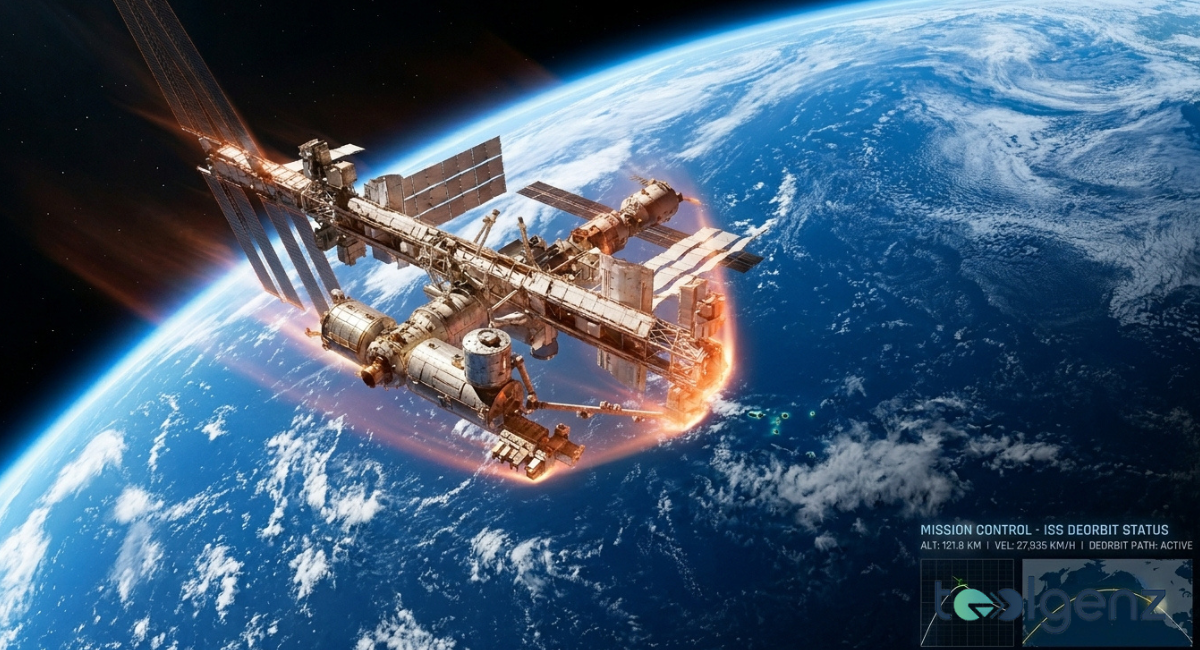
The International Space Station is widely regarded as one of the most ambitious achievements in modern space exploration. Orbiting Earth at incredible speed, it has served as a living laboratory where astronauts conduct research that benefits both space missions and everyday life on Earth. Over the years, it has also become a symbol of global cooperation, bringing together multiple nations under a shared scientific goal.
The International Space Station has supported thousands of experiments ranging from biology and physics to Earth observation and materials science. These studies have helped improve technologies, medical research, and our understanding of long-duration space travel.
Today, attention is shifting toward the future of the ISS as NASA prepares for its planned retirement. What was once focused on continuous operation is now moving toward a carefully managed end-of-life strategy, raising both technical and environmental discussions.
NASA Wants to Sink the ISS in the Pacific Ocean: Why Scientists Are Concerned
NASA’s plan for the International Space Station involves a controlled deorbit mission that will guide the aging structure back into Earth’s atmosphere. The goal is to ensure it does not reenter unpredictably, which could pose risks to people and infrastructure.
While engineers emphasize safety, some researchers argue that environmental impacts have not been studied in enough depth. Concerns focus on what happens when large amounts of spacecraft material from the International Space Station survive reentry and reach remote ocean regions.
Organizations such as environmental research groups have raised questions about whether deep-ocean disposal is truly harmless. They point out that even remote ecosystems may be affected by long-term material deposition.
The debate surrounding the International Space Station retirement now extends beyond engineering, touching on environmental ethics, ocean protection, and international responsibility.
Growing Debate Over the International Space Station’s Final Mission
The planned retirement of the International Space Station has sparked global discussion. While NASA views the mission as a necessary step forward, others see it as a moment that requires careful environmental reflection.
Some experts support the controlled approach because it reduces risks to populated areas. Others believe that more environmental review is needed before ending the International Space Station mission in such a dramatic way.
This discussion is no longer just about space operations—it has become a broader conversation about sustainability and responsibility in both orbit and Earth’s oceans.
Why Ocean Conservation Groups Are Raising Alarms
Marine conservation groups have expressed concern about the final phase of the International Space Station mission. Their main worry is that deep ocean disposal sites may not be as isolated or harmless as once assumed.
They argue that even remote seafloor regions can host fragile ecosystems that are not fully understood. If debris from the International Space Station reaches these areas, it could introduce long-lasting environmental changes.
The concern is not immediate damage but the uncertainty of long-term effects on deep-sea biodiversity and chemical balance.
What Is NASA’s Plan for the International Space Station?
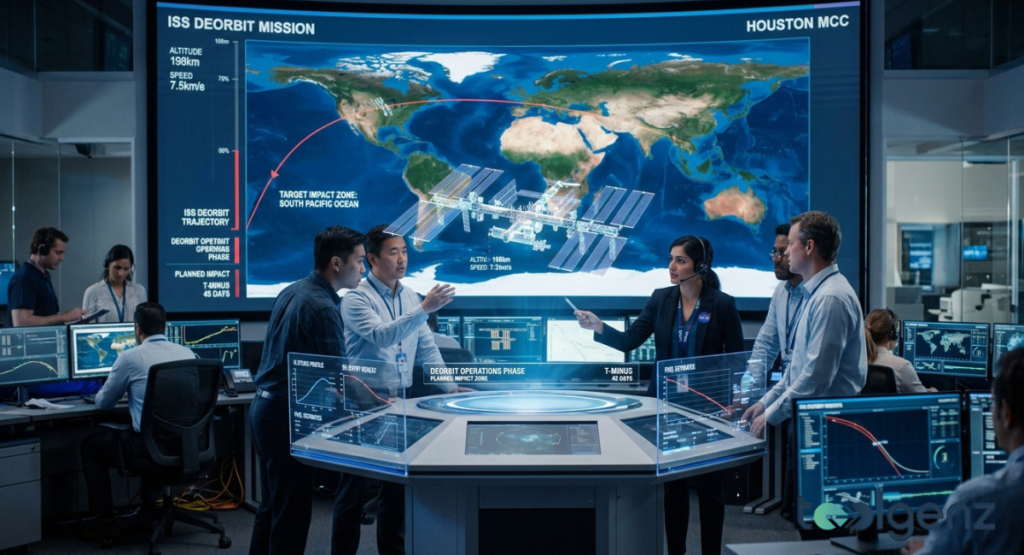
Every variable must be continuously monitored from Houston Mission Control to ensure absolute precision during descent.
NASA’s strategy for the International Space Station is based on controlled deorbiting rather than passive decay. This means the station will be gradually lowered from orbit using carefully planned maneuvers.
NASA engineers are working with private partners, including SpaceX, to ensure a safe and predictable descent.
A dedicated spacecraft will attach to the International Space Station and guide it into a controlled reentry path. This process is designed to minimize risks while ensuring most debris burns up in the atmosphere.
Overview of the ISS Retirement Plan
The retirement of the International Space Station will take place gradually over several years. Engineers will slowly reduce its altitude using both natural atmospheric drag and propulsion systems.
As the orbit lowers, the station will eventually reach a point where reentry becomes unavoidable. At that stage, final systems will guide the International Space Station toward a designated impact zone in the Pacific Ocean.
Why the International Space Station Can No Longer Operate Indefinitely
The International Space Station has been in orbit for more than two decades, and its systems are showing signs of aging. Constant exposure to radiation, micro-meteoroids, and temperature extremes has increased maintenance demands.
Over time, the cost and complexity of keeping the International Space Station operational will outweigh its benefits, making retirement the most practical option.
Key Objectives Behind NASA’s Deorbit Strategy
The main goal of retiring the International Space Station is safety. NASA wants to ensure that any surviving fragments land far from populated areas.
Another objective is to reduce congestion in low Earth orbit and make space safer for future missions. This transition also supports the development of next-generation commercial stations that will eventually replace the International Space Station.
Timeline for Deorbiting the Station
Current projections suggest the International Space Station will begin its descent process toward the end of this decade. Engineers will carefully monitor every stage of the operation.
Adjustments may be made depending on technical conditions, space traffic, and atmospheric behavior. The timeline remains flexible to ensure a safe outcome.
Major Milestones Between 2028 and 2031
The first phase will gradually reduce the orbit of the International Space Station. Later stages will prepare the structure for controlled reentry.
The final milestone will involve precise alignment for atmospheric entry, ensuring debris from the International Space Station follows a safe trajectory.
Launch of the U.S. Deorbit Vehicle (USDV)
NASA has selected a specialized spacecraft known as the U.S. Deorbit Vehicle to support the mission. This vehicle will attach to the ISS and provide the thrust needed for controlled descent.
It represents one of the most complex end-of-life missions ever planned for a space structure of this size.
Final Controlled Descent Schedule
The final descent of the International Space Station will occur only after all safety checks are complete. Mission controllers will oversee every step in real time.
Once initiated, the process will be irreversible, guiding the International Space Station toward atmospheric reentry and ocean impact.
Why NASA Chose the Pacific Ocean for the ISS Splashdown
NASA selected the Pacific Ocean because it offers vast remote areas far from human populations. This reduces any risk from surviving debris of the International Space Station.
The region has been used for spacecraft disposal before, making it a proven but still debated solution.
Understanding NASA’s Selection Process
Engineers consider shipping lanes, weather conditions, and population density when choosing a target zone. These factors help determine the safest possible location for the International Space Station reentry.
Safety Considerations for Populated Areas
A controlled descent ensures debris from the International Space Station avoids cities, airports, and shipping routes. Public safety remains the top priority throughout the mission.
The Concept of Point Nemo
The planned impact zone is near Point Nemo, one of the most remote locations on Earth. It is often referred to as the spacecraft “cemetery” because many retired objects, including parts of the International Space Station’s predecessors, have been directed there.
What Is Point Nemo?
Point Nemo is the oceanic pole of inaccessibility, located far from any landmass. Its isolation makes it an ideal candidate for managing the final stage of the International Space Station mission.
Why It Is Called the Spacecraft Cemetery
Over time, multiple spacecraft have ended their missions in this region. As a result, Point Nemo has become associated with the controlled disposal of large orbital structures, including the ISS .
Geographic Isolation and Ocean Conditions
The extreme remoteness of Point Nemo minimizes human risk. This makes it one of the safest available regions for the final descent of the International Space Station.
Previous Spacecraft Disposals in the Region
Earlier missions, including space stations and cargo vehicles, have been safely guided to this area. These examples provide valuable data for planning the International Space Station deorbit process.
How the ISS Will Be Brought Down Safely
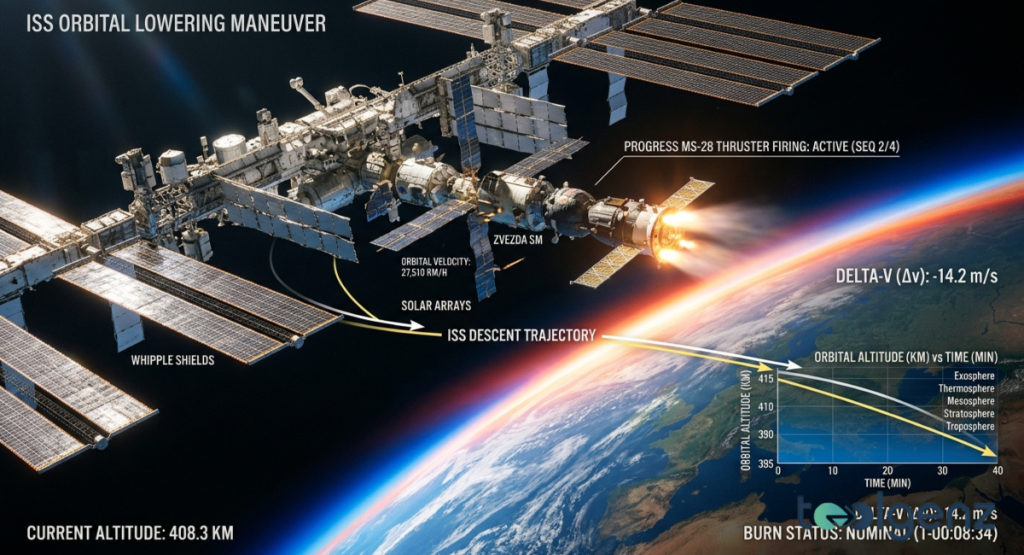
An illustrated chart maps altitude loss against time to track transition vectors through atmospheric layers.
Bringing down the International Space Station requires precise coordination of orbital mechanics, propulsion systems, and atmospheric modeling.
Engineers use simulations to predict how the structure will break apart during reentry, ensuring the safest possible outcome.
Controlled Re-entry Process
During reentry, the International Space Station will encounter intense heat and atmospheric pressure. This will cause most of the structure to disintegrate before reaching the ocean.
Only dense components may survive the descent, depending on their material strength and heat resistance.
Role of Deorbit Vehicles and Mission Planning
The success of the International Space Station retirement depends heavily on specialized spacecraft and long-term planning.
The deorbit vehicle will use thrusters to carefully guide the station into its final trajectory, ensuring controlled atmospheric entry.
What Happens to the ISS During Atmospheric Re-entry?
As the International Space Station reenters Earth’s atmosphere, friction will generate extreme heat. Most materials will burn up before reaching the surface.
Some heavier parts may survive, but engineers expect the majority of the structure to disintegrate during descent.
Could ISS Debris Harm Marine Ecosystems?
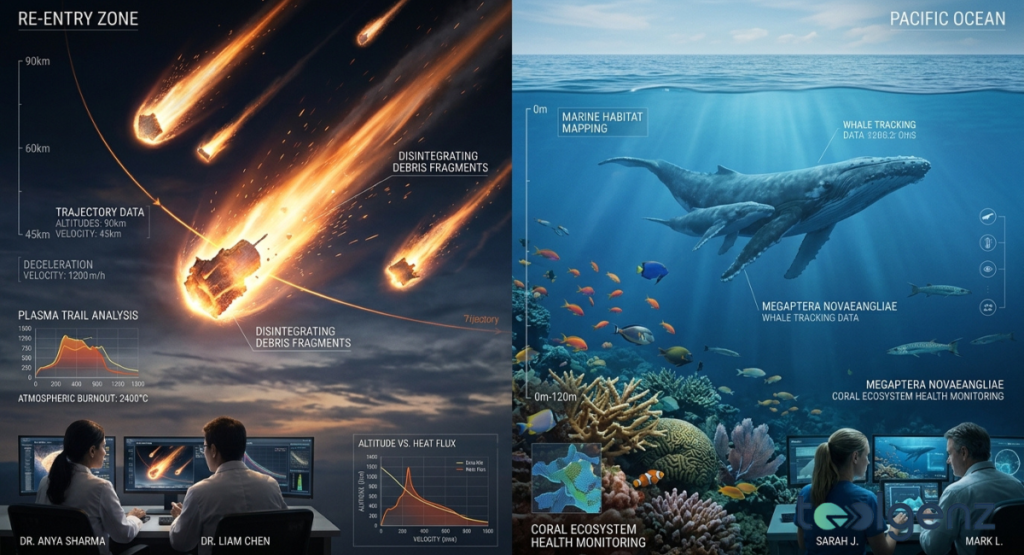
Proactive monitoring attempts to safeguard vulnerable coral reefs and migratory marine mammal paths from contamination.
Scientists are still studying whether debris from the International Space Station could affect deep ocean ecosystems. While the target zone is remote, it is not completely lifeless.
Researchers are particularly interested in long-term effects on marine biodiversity and sediment environments.
Why Some Researchers Are Calling for More Environmental Studies
Many experts believe more research is needed before finalizing the International Space Station disposal plan. They argue that better data would help understand long-term environmental impacts.
This includes studying how materials behave once they reach deep-sea environments.
NASA’s Response to Environmental Concerns
NASA has stated that the International Space Station deorbit plan is designed with safety as the highest priority. The agency believes controlled reentry is the most responsible option available.
Officials emphasize extensive modeling and international cooperation in planning the mission.
Legal Questions Surrounding the International Space Station Deorbit
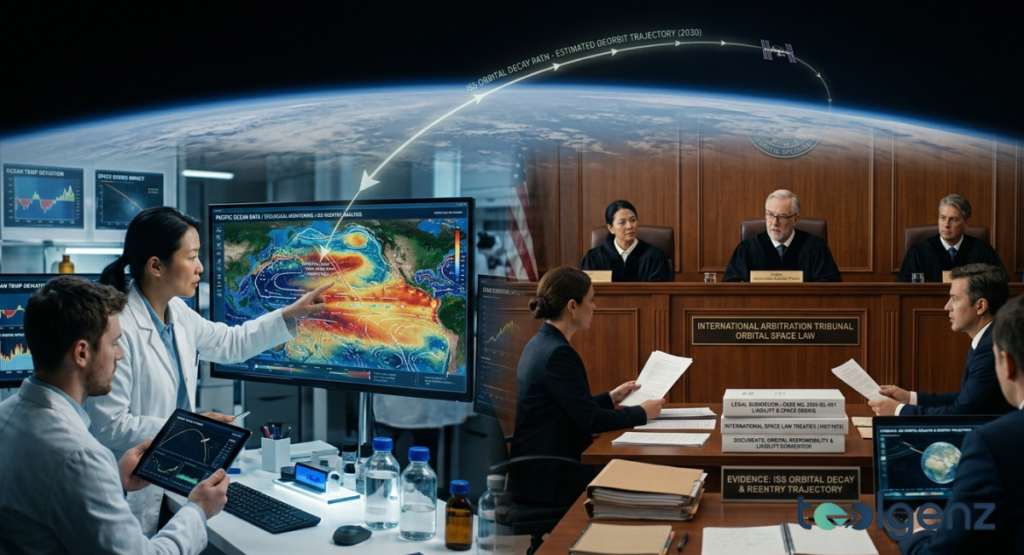
Establishing clear regulatory guidelines ensures that future space operations remain accountable for global environmental safety.
The retirement of the International Space Station also raises legal questions under international space and maritime law. Existing treaties such as space liability and ocean protection agreements may apply.
However, some experts believe new frameworks may be needed for large-scale spacecraft disposal.
What Will Happen After the ISS Is Retired?
The end of the International Space Station will mark a major transition in human spaceflight. NASA plans to shift focus toward commercial space stations and deep-space missions.
Future platforms will continue scientific research in low Earth orbit, ensuring that the legacy of the ISS continues in new forms.
Conclusion
The retirement of the International Space Station represents both an engineering milestone and a global discussion point. While NASA’s controlled deorbit plan prioritizes safety, environmental and legal concerns continue to shape the debate.
As the world prepares for the final chapter of the International Space Station, the mission highlights the balance between technological progress and environmental responsibility in modern space exploration.
FAQs
Why is NASA getting rid of the International Space Station?
NASA is retiring the International Space Station because it is aging and expensive to maintain, and it wants to transition to commercial platforms.
When can I see ISS in my location?
You can see the International Space Station during specific flyovers, usually near sunrise or sunset, using NASA’s tracking tools.
Which country is not allowed on the ISS?
No country is officially banned from the International Space Station, but participation depends on international agreements and partnerships.
How do female astronauts menstruate?
Female astronauts aboard the International Space Station manage menstruation normally using standard medical or hormonal options.