

The recent rally in micron stock has caught the attention of both retail and institutional investors. The company’s latest earnings report exceeded market expectations, fueled by surging demand for AI-driven memory solutions and a sharp increase in memory chip prices. As one of the world’s leading memory manufacturers, Micron is benefiting from rapid growth in artificial intelligence, cloud computing, enterprise data centers, and next-generation mobile technologies.
Investor confidence has strengthened as the company continues delivering solid financial results while expanding its position in high-growth markets. Whether you’re already following the semiconductor industry or exploring new investment opportunities, understanding the factors behind micron stock can provide valuable insight into the company’s long-term potential.
Why Micron Stock Jumped 15%
Strong Quarterly Earnings Beat Expectations
Micron’s latest quarterly results were the primary catalyst behind the sharp rally in micron stock. The company reported revenue and earnings that comfortably surpassed Wall Street expectations, demonstrating that demand for its memory products remains exceptionally strong despite broader economic uncertainty.
Beyond beating analyst forecasts, Micron also posted impressive growth in adjusted earnings per share, stronger operating margins, and record sales across several business segments. These results reflect increasing demand from cloud providers, AI infrastructure projects, and enterprise customers that require advanced memory technologies to support expanding workloads.
The positive earnings surprise reinforced investor confidence, with many analysts viewing the results as evidence that Micron is entering another strong growth cycle supported by long-term technology trends.
Revenue Quadrupled Year Over Year
One of the biggest highlights from the earnings report was the company’s remarkable year-over-year revenue growth. Compared with the same quarter last year, revenue increased dramatically, reflecting strong demand across nearly every major business unit.
Growth was particularly impressive in cloud computing, enterprise storage, automotive technology, and mobile devices. Data centers continue investing heavily in AI infrastructure, creating sustained demand for high-performance memory products capable of handling increasingly complex computing tasks.
Rather than relying on a single source of revenue, Micron has built a diversified business that benefits from multiple industries growing at the same time. This balanced approach gives investors greater confidence in the long-term outlook for micron stock.
| Key Financial Metric | Previous Year | Latest Quarter |
|---|---|---|
| Revenue | $9.3 Billion | $41.46 Billion |
| Adjusted EPS | Lower | $25.11 |
| Gross Margin | 39% | 84.9% |
| Net Income | $1.89 Billion | $28.24 Billion |
Rising Memory Prices Fueled Investor Optimism
Another major driver behind Micron’s strong performance has been the steady increase in global memory prices. Demand for advanced DRAM and NAND products continues to outpace available supply, giving leading manufacturers greater pricing power.
Instead of lowering prices to attract customers, Micron has been able to sell nearly all of its available production while maintaining healthy profit margins. This favorable market environment has significantly improved earnings and strengthened the investment case for micron stock.
Higher memory prices, combined with continued AI-related demand, suggest that the company could continue benefiting from favorable industry conditions in the coming quarters.
How Wall Street Reacted to the Earnings Report
Analysts responded positively to Micron’s latest financial results, with several investment firms raising their price targets shortly after the earnings announcement. Many believe the company is benefiting from structural changes in the technology sector rather than a short-lived recovery.
Wall Street also highlighted Micron’s growing base of long-term customer agreements, which provide greater visibility into future revenue and help reduce uncertainty during industry cycles. These contracts support more predictable cash flow while allowing the company to plan future manufacturing investments with greater confidence.
For many investors, the combination of strong financial performance, expanding AI demand, and disciplined execution makes micron stock one of the more attractive opportunities in today’s semiconductor market.
Micron’s Historic Revenue and Earnings Results

Earnings momentum shows how memory demand and AI workloads fueled multi-year growth.
Revenue Growth Compared With Previous Quarters
Micron’s latest quarterly performance represents one of the strongest periods in the company’s recent history. Revenue increased significantly compared with previous quarters, supported by healthy demand across cloud computing, enterprise storage, consumer electronics, and AI infrastructure.
Rather than depending on a single business segment, the company generated growth from multiple markets. Higher demand for memory used in smartphones, automotive systems, industrial equipment, and embedded technologies created a well-balanced revenue mix. This diversified business model reduces reliance on any one customer or industry, making micron stock more attractive to investors seeking long-term stability.
Another encouraging sign is the consistency of Micron’s performance. The company continues expanding its customer base while strengthening relationships with major technology firms that require reliable memory solutions for next-generation products.
Record Profit Margins and Net Income
Revenue growth is only part of the story. Micron also delivered exceptional profitability, showing that higher sales are translating into stronger financial performance.
Improved pricing, efficient manufacturing, and disciplined cost management helped the company achieve record gross margins. At the same time, net income increased substantially, reflecting the company’s ability to convert strong demand into meaningful earnings growth.
For investors, this combination of rising revenue and expanding profit margins is particularly encouraging. Companies that consistently improve both sales and profitability often create greater long-term shareholder value, reinforcing the positive outlook for micron stock.
Business Segment Performance Breakdown
Several business divisions contributed to Micron’s impressive results, demonstrating broad-based demand across the technology sector.
Data centers remained one of the strongest performers as hyperscale cloud providers continued expanding AI infrastructure. Enterprise storage products also experienced healthy demand, while smartphone manufacturers increased orders for advanced memory components used in premium mobile devices.
The automotive segment delivered another solid quarter as modern vehicles require greater processing power and larger memory capacity to support advanced driver assistance systems and connected technologies. Industrial and embedded solutions also continued gaining momentum, providing additional revenue streams beyond traditional consumer markets.
| Business Segment | Primary Growth Driver | Performance |
|---|---|---|
| Data Centers | AI Infrastructure | Exceptional |
| Cloud Computing | Enterprise Storage | Very Strong |
| Mobile Devices | Premium Smartphones | Strong |
| Automotive | Smart Vehicle Technology | Rapid Growth |
| Embedded Systems | Industrial Applications | Growing |
Financial Metrics Investors Should Watch
While quarterly earnings often receive the most attention, experienced investors monitor several financial indicators before making investment decisions.
Future revenue guidance, operating margins, production capacity, free cash flow, and customer commitments all provide valuable insight into Micron’s long-term outlook. These metrics help investors determine whether the company’s recent momentum can continue over the coming years.
Another factor worth watching is the growing number of long-term supply agreements. These contracts allow customers to secure future memory shipments while giving Micron greater visibility into production planning and future revenue. As demand for advanced memory continues rising, these agreements could become an important competitive advantage for micron stock.
How the Memory Crunch Is Driving Higher Prices
Why Global Memory Supply Remains Tight
The global memory market continues facing supply constraints as demand grows faster than manufacturers can expand production. Building new semiconductor fabrication facilities requires years of planning and billions of dollars in investment, making it difficult for supply to keep pace with rapidly increasing demand.
Artificial intelligence has accelerated this imbalance. Every new AI server requires significantly more memory than traditional computing systems, placing additional pressure on global production capacity. As a result, customers are competing for available inventory, allowing memory manufacturers to maintain stronger pricing.
This favorable supply-and-demand environment continues supporting higher margins and provides another positive factor for micron stock.
DRAM and NAND Price Trends Explained
Demand for DRAM and NAND products has increased steadily over the past year as businesses invest more heavily in cloud computing, AI development, enterprise storage, and high-performance computing.
These technologies require faster processing speeds and larger storage capacity, driving demand for advanced memory solutions across multiple industries.
Growth is not limited to artificial intelligence alone. Smartphone manufacturers are introducing devices with greater memory requirements, businesses continue upgrading enterprise infrastructure, and automotive companies are integrating increasingly sophisticated digital systems into modern vehicles. Together, these trends create multiple sources of demand that strengthen the overall semiconductor market.
The AI Boom and Its Impact on Micron

HBM3E and high-bandwidth DRAM are critical for training and inference at scale.
AI Servers Are Creating Massive Memory Demand
Artificial intelligence has quickly become one of the biggest growth drivers for the global technology industry, and memory chips are at the center of that transformation. Every AI model relies on enormous amounts of data, requiring high-speed memory to process information efficiently. As organizations continue investing in AI infrastructure, Micron is benefiting from a sharp increase in demand for its products.
Unlike conventional servers, AI systems require significantly larger memory capacity to handle complex workloads. This trend is encouraging cloud providers, enterprise businesses, and technology companies to expand their data center investments. As AI adoption continues across industries, many investors believe micron stock is well positioned to benefit from this long-term shift.
High-Bandwidth Memory (HBM) Is Becoming Essential
High-Bandwidth Memory (HBM) has become one of the most valuable technologies powering modern AI hardware. It enables processors to move large volumes of data quickly, improving performance in machine learning, generative AI, and advanced computing applications.
Demand for HBM continues rising as companies build more powerful AI systems capable of handling increasingly complex workloads. Industry experts expect this market to expand for years, creating additional opportunities for memory manufacturers that can deliver advanced products at scale.
For Micron, continued investment in HBM strengthens its position in one of the fastest-growing areas of the semiconductor industry and supports the long-term outlook for micron stock.
Why Nvidia, Google, and Cloud Providers Need Micron
Major technology companies continue investing billions of dollars in AI infrastructure, and advanced memory remains a critical part of every system they build. High-performance processors require equally capable memory solutions to deliver maximum efficiency.
As cloud providers expand their data centers and AI platforms, demand for Micron’s memory products continues increasing. Long-term relationships with leading technology companies provide recurring business opportunities while strengthening the company’s position within the broader AI ecosystem.
These partnerships not only support revenue growth but also increase confidence that micron stock can benefit from sustained demand over the coming years.
AI Infrastructure Spending Could Sustain Growth
AI investment shows no signs of slowing. Governments, multinational corporations, cloud providers, and software companies continue allocating significant resources to artificial intelligence projects.
Every new AI deployment requires additional computing power, storage, and memory capacity. Because memory demand grows alongside processing requirements, Micron stands to benefit as organizations continue expanding their AI capabilities.
If current investment trends continue, the company could enjoy several years of healthy demand, making micron stock an attractive option for investors focused on long-term technology growth.
| AI Growth Driver | Impact on Micron |
|---|---|
| AI Data Centers | Higher memory demand |
| Cloud Expansion | Increased memory shipments |
| High-Bandwidth Memory | Premium pricing opportunities |
| Enterprise AI | Long-term revenue growth |
| AI Servers | Improved profitability |
Why Wall Street Is Calling Micron a Top Growth Stock
Analyst Upgrades and Higher Price Targets
Following Micron’s latest earnings report, several Wall Street firms raised their price targets and reaffirmed positive ratings on the company. Analysts pointed to stronger-than-expected financial results, improving margins, and continued AI-related demand as key reasons for their optimism.
Many now believe Micron is entering a more sustainable growth phase compared with previous semiconductor cycles. The company’s ability to capitalize on expanding AI infrastructure while maintaining financial discipline has strengthened its investment appeal.
Why Growth Investors Are Paying Attention
Growth investors typically look for businesses operating in expanding markets with durable competitive advantages. Micron fits that profile by supplying essential memory products used across artificial intelligence, cloud computing, enterprise storage, automotive technology, and consumer electronics.
The company also benefits from multiple revenue streams, reducing dependence on any single industry. This balanced approach gives investors greater confidence in future earnings while making micron stock an increasingly popular choice among technology-focused portfolios.
Institutional Buying and Market Confidence
Large institutional investors generally favor companies with predictable revenue, strong balance sheets, and clear long-term growth opportunities. Micron’s expanding customer relationships and multi-year supply agreements help provide that stability.
These long-term contracts improve production planning, support future manufacturing investments, and reduce uncertainty during industry cycles. As institutional ownership grows, it often reflects confidence in the company’s long-term business strategy.
What Analysts Expect Next
Most analysts expect healthy demand to continue over the next several years as AI infrastructure expands and enterprise technology spending remains strong. While short-term market volatility is always possible, many believe Micron has positioned itself well for future growth.
Investors will continue watching upcoming earnings reports, production capacity, and pricing trends to determine whether the company can maintain its current momentum.
What Makes Micron Different From Other Semiconductor Stocks?
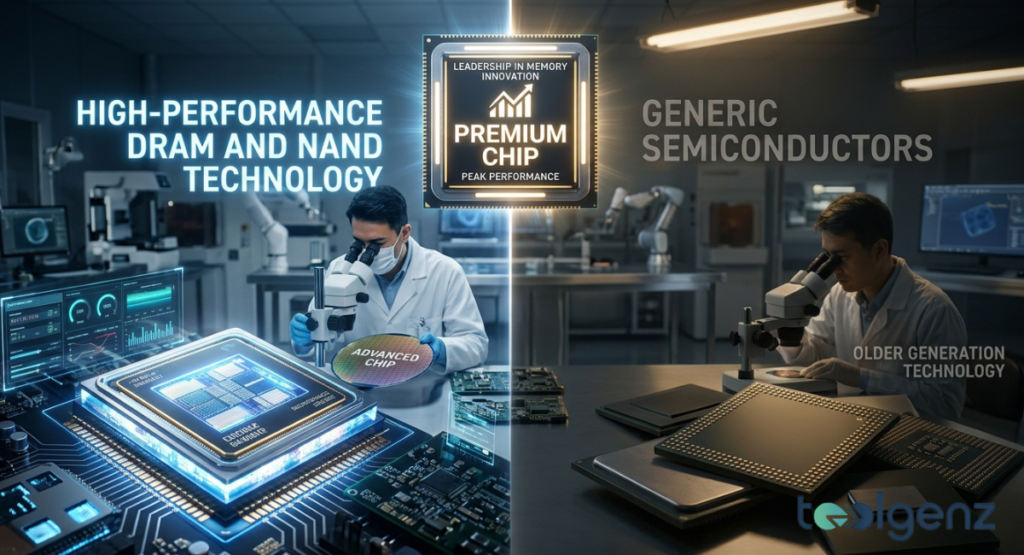
Leadership in DRAM and NAND tech separates Micron from broad chip peers.
Micron vs. NVIDIA
Although Micron and NVIDIA both benefit from the rapid expansion of artificial intelligence, they operate in different parts of the semiconductor industry. NVIDIA develops the processors that perform AI calculations, while Micron supplies the advanced memory needed to support those processors.
Rather than competing directly, the two companies benefit from the same long-term trend: increasing demand for AI infrastructure. As more businesses deploy advanced computing systems, both processing power and memory become equally important.
Micron vs. Samsung and SK Hynix
Micron competes with some of the world’s largest memory manufacturers, including Samsung and SK Hynix. Despite strong competition, the company continues differentiating itself through advanced technology, manufacturing efficiency, and close collaboration with major customers.
Its focus on innovation and premium memory solutions allows Micron to compete effectively while maintaining healthy profit margins, even in a highly competitive market.
Risks That Could Affect Micron Stock
Memory Price Volatility
Although Micron is benefiting from favorable market conditions, the memory industry has always been cyclical. Prices can rise quickly when demand exceeds supply, but they can also decline once production catches up. Investors should keep this cycle in mind when evaluating micron stock as a long-term investment.
A significant increase in global production or weaker-than-expected demand could place pressure on pricing and reduce profit margins. Even well-managed semiconductor companies experience periods of slower growth during industry downturns.
Economic Slowdowns and Semiconductor Cycles
The semiconductor sector is closely tied to global economic activity. During periods of slower economic growth, businesses may delay infrastructure investments, while consumers often reduce spending on smartphones, computers, and other electronic devices.
Although artificial intelligence continues to support strong demand today, broader economic conditions can still influence future revenue. Investors considering micron stock should balance the company’s growth opportunities with the normal risks associated with cyclical technology markets.
Competition and Geopolitical Risks
Micron also faces intense competition from major global memory manufacturers. At the same time, trade restrictions, geopolitical tensions, and supply chain disruptions can affect production, customer demand, and international sales.
The company has strengthened its position through continuous innovation, manufacturing efficiency, and long-term customer relationships. While these advantages help reduce business risk, they cannot completely eliminate external challenges facing the semiconductor industry.
Cyclicality of the Semiconductor Industry
Every semiconductor cycle eventually shifts from expansion to slower growth as supply and demand rebalance. Companies that perform well during strong markets may experience temporary slowdowns when inventories increase or customer spending weakens.
For long-term investors, occasional volatility should be expected. Those who understand these market cycles may be better prepared to evaluate micron stock with a longer investment horizon rather than focusing only on short-term price movements.
Micron Stock Outlook for 2026

Tech index strength and AI infrastructure buildout shape the bullish case for memory.
Revenue Growth Forecast
Industry forecasts remain encouraging as artificial intelligence, cloud computing, and enterprise technology continue expanding worldwide. Demand for advanced memory products is expected to remain healthy, particularly among hyperscale cloud providers and organizations investing heavily in AI infrastructure.
If memory pricing remains favorable and customer demand continues growing, analysts believe micron stock could benefit from another period of steady revenue growth over the next several years.
AI Demand Outlook
Artificial intelligence is rapidly becoming part of everyday business operations across healthcare, finance, manufacturing, education, and countless other industries. Each new AI application increases demand for faster processing, larger storage capacity, and more advanced memory technologies.
Because Micron supplies products that support these workloads, the company remains well positioned to benefit from continued AI adoption.
Future Capacity Expansion
To meet growing customer demand, Micron continues investing in new manufacturing facilities and advanced production technologies. Expanding capacity should help the company serve larger customers while supporting future revenue opportunities.
Management’s ability to balance production growth with market demand will remain an important factor in maintaining profitability over the long term.
Potential Catalysts That Could Move the Stock
Several developments could influence future performance, including stronger enterprise technology spending, additional AI investment, favorable memory pricing, successful product launches, and continued execution of long-term customer agreements.
Positive quarterly earnings, disciplined capital allocation, and steady demand could all provide additional support for micron stock in the years ahead.
Should You Buy Micron Stock Right Now?
Reasons Bulls Remain Optimistic
Supporters believe Micron is benefiting from one of the most important technology trends of the decade. Artificial intelligence continues driving demand for advanced memory, while cloud providers and enterprise customers keep expanding their infrastructure investments.
Strong financial performance, improving profitability, and long-term customer relationships all strengthen the company’s investment case.
Concerns That Bearish Investors Highlight
More cautious investors point to valuation, industry cyclicality, and the possibility of declining memory prices once supply increases. They also recognize that semiconductor stocks often experience periods of significant volatility, even during long-term growth cycles.
These concerns do not necessarily weaken the company’s long-term outlook, but they do highlight the importance of maintaining realistic expectations before investing.
Who Should Consider Buying Micron Stock
Investors with a long-term perspective and an interest in the semiconductor industry may find micron stock appealing because of its growing role in artificial intelligence, cloud computing, and enterprise technology. Those comfortable with market volatility may also appreciate its long-term growth potential.
Who May Prefer to Wait
More conservative investors may prefer waiting for additional earnings reports, improved valuations, or broader market pullbacks before opening a position. Taking a patient approach can sometimes provide better entry opportunities without changing the long-term investment thesis.
Final Verdict: Is Micron Still a Strong Growth Opportunity?

Micron Technology chip glows at the center as AI and market risk charts balance on each side of the scale.
Key Takeaways From Micron’s Performance
Micron has evolved into one of the semiconductor industry’s most important memory suppliers, serving fast-growing markets such as artificial intelligence, cloud computing, enterprise storage, automotive technology, and mobile devices.
Its recent financial performance demonstrates that strong execution, rising demand, and disciplined operations can produce impressive business results.
Long-Term Investment Potential
The company’s expanding customer base, continued investment in advanced memory technology, and growing presence within AI infrastructure create a solid foundation for future growth. While industry cycles will continue, Micron appears well positioned to benefit from long-term technology trends.
Valuation and Future Growth Prospects
Investors should continue monitoring future earnings, production capacity, and memory pricing when evaluating the company’s outlook. Sustainable execution and consistent profitability will likely remain the biggest drivers of future performance.
Overall, micron stock continues to attract attention because it combines exposure to artificial intelligence with leadership in one of the technology sector’s most essential components. Although no investment is without risk, the company’s long-term growth opportunities remain compelling for investors willing to navigate normal market volatility.
FAQs
Is Micron stock a buy or a sell?
Many analysts currently rate Micron as a Buy due to strong AI-driven demand, improving earnings, and healthy revenue growth. However, every investor should evaluate their own financial goals and risk tolerance before making an investment decision.
Is Micron a better stock to buy than NVIDIA?
The answer depends on your investment strategy. NVIDIA dominates AI processors, while Micron specializes in memory technology that powers those systems. Both companies benefit from AI growth but serve different roles within the semiconductor ecosystem.
What does Jim Cramer say about Micron?
Jim Cramer has generally expressed a positive opinion on Micron, highlighting its improving financial performance, strong AI-related demand, and favorable position within the memory chip industry.
Can Micron stock reach $1,000?
Reaching $1,000 per share would require extraordinary long-term growth and a significantly larger market capitalization. While anything is possible over a very long time frame, most analysts do not currently project that valuation.
Does Warren Buffett own Micron stock?
Based on the most recently disclosed public filings, Warren Buffett and Berkshire Hathaway do not currently own Micron shares.